Tuesday, October 19, 2010

Ceremony Commemorates Great Hanging 2010

Last Saturday, the fourth annual Gainesville Hanging Commemoration was sponsored by the Cooke County Historical Commission.  The following newspaper article is from the GAINESVILLE DAILY REGISTER, Gainesville Texas. October 18, 2010

Ceremony Commemorates Great Hanging
By PAMELA ROBINSON, Register Staff Writer
Gainesville Daily Register

Gainesville — History can lie buried, like a civilization covered over by centuries of dust and then layers of earth. But, it is still there, and can be brought back to life by someone researching the site or event.

The Gainesville history of The Great Hanging was unearthed by Leon Russell, who made it his business to shed light on an unsettling event that took place in our town.  Russell is credited for starting the yearly ceremony to commemorate the victims of The Great Hanging which took place in 1862.

Saturday morning, Russell was at the fourth commemoration in his wheel chair and one arm in a sling, at the Georgia Bass Park, the actual site of the hangings in 1862. He said his intent has always been to bring justice to a group of men whose lives were ended.

During the ceremony Ron Melugin, Chair of the Cooke County Historical Commission and fellow commission member Colleen Clark Carri, walked through the rows of crosses and read each name and rang a bell in remembrance of each person.

Russell then spoke to those at the gathering.  “Now that we’ve heard the names, who are these people?” Russell asked. “Well, for the most part, they were non-slave owners, with one or two exceptions, and for the most part they were out in the eastern part of the county and for the most part, they were grubbing their living out of a little garden spot and trying to perfect their claim under the Peters colony. Most of them would have been subject to the draft, the Confederate draft, and they really didn’t want to go fight the rich man’s war, the planter’s war. They left 42 widows and about 170 children.”

Russell joked that people might look at him and say, “well, what’s an old guy in that shape, what would be his interest in something like this, and I can tell you right quick, when I first learned of this I thought it was just such a horrible injustice. And this is a country that’s supposed to have been formed on the basis of justice. What happened to the idea that every man is considered innocent until proven guilty by a competent court by a jury of his peers?”  Russell became very emotional during his address and said, “The people that did it trashed that and I’m here to speak out against them. And if I don’t get to say anything more, I hope they’re watching,” he said as he looked around, “because I want to say, ‘you didn’t get us all yet,’” to the applause of the gathered audience.

Russell himself is not a descendant of anyone involved in The Great Hanging but said, “The scale of justice has to be re-balanced somewhere, that’s our fundamental belief.”

L.D. Clark was the featured speaker at the commemoration and wrote the book, “A Bright Tragic Thing,” about the hanging.  Melugin introduced Clark as a noted author and specialist on the Great Hanging and a decedent of Nathaniel Miles Clark who was hanged. Clark is now as a resident of Gainesville. 
“You know why we are gathered here today? Because 148 years ago in 1862, there started what is called a ‘reign of terror’ in Gainesville because over a three-week period, 42 men were hanged and a couple were shot. This went on for three weeks and you can imagine what it was like in the whole county,” Clark started. “They had a so-called jury...You might as well say it was a mob to begin with.”

Clark said most of the people got the sham trial, but pointed out that his ancestor Nathaniel Miles Clark and 11 other men never even got the sham trial. “When everything is going into chaos, that’s when the rule of law is supposed to kick in,” Clark said.

Clark introduced two of Ephraim Chiles’ great-granddaughters, Barbara Parcell of North Richland Hills and Shirley Clough of Kansas. Clough addressed the audience and told them about the history they are working on, which led then to Gainesville for the first time for the commemoration. Chiles and his brother Henry Chiles were the first two men to be hanged.

The Commemoration of the Great Hanging started four years ago after Russell went before the Gainesville city council to start the ceremony.  “He felt it just needed to be done,” his daughter Gayle Russell said.  Russell grew up in Woodbine and when someone mentioned The Great Hanging to him, he had no idea what they were talking about.  “It started hanging on his heart,” Carri said, “and he contacted Ron Melugin and said ‘I want to do something about it and I’m running into roadblocks and I can’t get anybody to talk to me about this.’ Ron said, ‘well, I’ll talk about it. So one thing led to another...’”

Russell and his wife and his nurse also made the crosses, one for each victim, for the commemorations.

The commemoration is sponsored by the Cooke County Historical Commission.

A huge memorial stone commemorating the events is located in Georgia Bass Park. The park is located between California Street and Main Street and is east of Pecan Creek.


Previous Memorial Events:

Friday, August 27, 2010

Arphax Dawson

Given name is spelled various ways: Arphaxton/Arphax/Arphaxad . It is a biblical name and reference to it can be found in the Book of Genesis 10:22. Arphaxad was the son of Shem and grandson of Noah.

Richard B. McCaslin's book "Tainted Breeze," gives this account of Arphax:
"Arphax R. Dawson immigrated to Texas from Illinois; he is listed in the 1860 Grayson County census (F.N. 642) as a farmer from Georgia, age fifty-five, with $3,297 in real and personal property. His wife, Jane, was from Tennessee; their five children had been born in Illinois, Missouri, and Texas. Their oldest daughter, Mary Ann, married Rama Dye on June 27, 1861."

Arphaxton. R. Dawson was born 1805 in Oglethorpe County, Georgia. He was married about 1824 to Mary HORN near Sewanne, Franklin, Tennessee. They had twelve known children (listed below). Mary died in 1856 in Franklin County, Illinois. Arphax then married Jane Caroline Stalcup. They had three known children (listed below.) He and second wife, Jane, were living in Sherman, Grayson County in October 1862. Arphaxton R. DAWSON died 19 Oct 1862 "The Great Hanging" at Gainesville. He was 57 years old at the time of his death. Some online accounts state that his body was taken back to Grayson County for burial, but NO burial site is known.

During the proceedings of the ‘Citizens Court” Arphax gave testimony in the trial of his son-in-law, Ramey Dye.  Testimony: “Ramey Dye came to my house and told me that M. D. Harper had been arrested on the charge of being connected with our society; and that there would be a meeting held that night, (1 Oct 1862) near Lattimer’s and Richies’ steam mill, for the purpose of consulting how to rescue Harper. He wished me to attend and bring my gun, which I did. The meeting was attended by Ramey Dye, John M. Wiley, Isham Welch, Wm Boyles, Jon Ware, H. Gilman, Robt Duncan and others. He talked about the rescue of Harper. We came to the conclusion that the force at Gainesville was too strong for us to accomplish our purpose.”
Arphax Dawson was tried in a group trial (5 men) and found guilty of “giving the signs, grip, and password, and were active members of Capt Ramey Dye’s company.” They were found guilty and hanged.
George Washington Diamond's Account of the Great Hanging at Gainesville, 1862, ManuscripteEdited by Sam Acheson and Julie The Southwestern Historical Quarterly, Vol. LXVI, January, 1963, No. 3, pages 331-414

In the "Tainted Breeze," McCaslin states that "Arphax R. Dawson and James A. Ward, had tried to flee the state but found their way across the Red River blocked by unseasonably high water brought on by the deluge of October 1."

Rama Dye, the son-in-law of Arphax Dawson, was also tried by the 'Citizens Court', found guilty of treason and hanged.  His wife, Mary Ann Dawson Dye, lost both her husband and father during those dreadful October days when so many men were hanged.

Arphax had three sons who fought in Confederate units.  According to a descendant, Ephriam A. Dawson was serving in a Confederate Texas Cavalry unit on the very day that his father was hanged by the confederates in Gainesville .

Arphax can be found in the following census records:
Census: 1840 in Franklin County, IL
Census: 1850 in Franklin County, IL
Census: 1860 Grayson County, Texas

Jane Dawson, was married once before. Her first husband is believed to be William Bland. In the 1860 census, 2 boys named James BLAND (b. abt 1850 TN) and John R. J. BLAND (b. abt 1853 TN) are living in the Dawson household. Jane C. and Arphaxton married in late 1856 or early 1857 (no marriage record found) as they had their first child Arfax DAWSON in 1857 in Missouri on their way down to Texas from Illinois.

Arphaxton and Mary HORN had the following children:
1. Allen DAWSON b. 1825 d. 1877 m. 1848 Mary C. VAUGHN; buried in Dawson Cemetery, Franklin Co., IL Descendants known.
2. Minerva DAWSON b. 1826 Alabama; m. 1850 William J. FLETCHER in Franklin Co., IL; descendants known (she names one of her sons Arfax)
3. Susan DAWSON b. abt 1827 m. HARRISON Descendants unknown
4. Rebecca Jane DAWSON b. abt 1828 AL; m. 1850 George LEFLER in Franklin Co., IL; descendants known
5. William DAWSON b. abt 1829 m. Melinda HAMON Franklin Co., IL; some descendants known
6. Juda "Judith" DAWSON b. abt 1834 White Co., IL m. 1853 Henry FLETCHER Franklin Co., IL; descendants known.
7. Samuel J. DAWSON b. abt 1838 AL; m. 1859 Mary Jane SKAGGS Cooke Co., TX; descendants not known
8. Ephraim A. DAWSON b. 1840 Franklin Co., IL; d. 1926 Cooke Co., TX; buried Mt. Zion Cemetery, Cooke Co., TX; m. 1861 (1) Sarah Jane WARD 1861 (2) Lucinda PARSONS 1868; descendants known
9. Mary Ann DAWSON b. abt 1843 Franklin Co., IL; m. 1861 (1) Rama DYE in Cooke Co., TX (he was also hanged in The Great Hanging Oct 1862) and (2) William T. HORTON ; descendants unknown
10. Nancy Catherine DAWSON b. abt 1845 Franklin Co., IL; m. 1861 A. DICKERSON in Grayson Co., TX; unknown descendants
11. George W. DAWSON b. abt 1846 Franklin Co., IL; m. (1) Cordelia REEVES (2) Sarah HUFFACRE in 1867 Cooke Co., TX; descendants unknown
12. Canzada DAWSON b. abt 1849 Franklin Co., IL; m. William KING in TX; nothing more known

Arphax R. DAWSON and his second wife Jane had the following children:
1. Arfax DAWSON b. 1857 Missouri; m. 1882 Mary Elizabeth FUTRELL in Dallas, Dallas, TX. She died in 1883 and nothing more in known of Anfaxton.
2. America Jane DAWSON b. 1859 Sherman, Grayson, TX;
d. 1939 Willis, Marshall, OK, buried in Marlow, Stephens, TX
m. Dennis Morgan MURPHY 1874 in Dallas Co., TX; descendants known.
3. Parthena T. DAWSON b. 27 Jun 1861 Sherman, Grayson, TX; d. 1916 Dallas, Dallas, TX; buried Laurel Oaks Cemetery, Old Bennett Cemetery section, Mesquite TX. She married (1) James WILLS 1877 Dallas Co., TX; ended in divorce; she had one child, Mary, with him; nothing known of her. (2) Samuel Wayne FUTRELL in 1882 Dallas, Dallas, TX; Descendants known.

Arphaxton R. DAWSON's second wife, Jane C. remarried Creed Taylor WALTHALL, a minister and farmer, on 26 Jan 1864 in Grayson County, Texas. They had the following children: Thomas WALTHALL b. abt. 1864 and Milton WALTHALL b. abt 1866 - nothing more in known about them.
Jane C. Dawson Walthall d. 1902 Dallas, Dallas, TX; buried in the Laurel Oaks Cemetery (Bennett section) in Mesquite, TX

What Were Their Occupations?

What were their occupations?

In October 1862, 42 men were tried for their Union Sympathies and convicted by a Confederate ‘Citizens Court’ in Gainesville, Texas. 40 men were hanged and several were shot while trying to escape. 

According to McCaslin, “Many of the victims were not of the lower echelons or fringes of society, but instead could claim to be middle-class.”

The following is a list of ‘Great Hanging’ men and their known occupations. Since most came to Texas to become landowners and farm, the majority of the men were obviously farmers, but it’s surprising to see other occupations represented as well.  Many of the men had trades or held county offices.  Known talents, such as being a musician, are also noted.

Any corrections or additions to this list of the men and/or their occupations are welcome! 

1. C. F. (E. F., Frosty, Edward) Anderson - farmer
2. George W. Anderson - farmer
3. Richard J. Anderson - ?
4. William B. Anderson - farmer
5. Thomas O. Baker - farmer
6. Bennet C. Barnes - farmer
7. Barnibus Burch - farmer
8. Samuel Carmichael - carpenter
9. Ephraim Chiles - farmer
10. Henry Chiles - physician
11. Nathaniel M. Clark - farmer
12. Henry Cockrum- -farmer, miller
13. John Mansil Crisp - blacksmith
14. Arphaxton R. Dawson - farmer
15. Rama Dye – farmer, justice of the peace, minister, road overseer
16. Hudson John Esman – farmer, musician
17. Henry S. Field - shoemaker
18. Thomas B. Floyd (shot) - farmer
19. James T. Foster (shot) - physician
20. Curd Goss - farmer
21. Edward D. Hampton - farmer
22. M. D. Harper - carpenter
23. William W. Johnson - farmer, Clark called him Dr. Johnson
24. C. A. Jones - ?
25. David Miller Leffel - carpenter
26. Leander W. P. Jacob Lock - farmer
27. Abraham McNeese – farmer
28. Richard N. Martin - farmer
29. John M. Miller – carpenter, teacher, musician
30. John A. Morris - farmer
31. Wash Morris - farmer  OR John W. Morris - farmer
32. M. Wesley Morris - farmer
33. William W. Morris - farmer
34. James A. Powers – “sawer”
35. William R. Rhodes - farmer
36. Alexander D. Scott - farmer
37. Eli M. Scott - farmer, road overseer
38. Gilbert Smith - farmer
39. William B. Taylor - farmer
40. Eli Sigler Thomas - physician
41. James A. Ward - farmer
42. William Wilson Wornell - farmer
==
43. William Boyles (later shot and possibly died from wounds) - farmer
44. Hiram Kilborn (shot) - road overseer, school trustee, poll supervisor, Baptist preacher
====
Other men that were killed during that time:
Hanged by James Young:
   William A. McCool - ?
   John M. Cottrell -?
   A.N. Johnson - ?
E. Junius Foster, shot by Young, newspaper editor of the Sherman Patriot, shot as he was closing up newspaper office.

The above occupations were found using census records, family histories, and the James L Clark book


Related Posts:
List of Men who Died in Hangings 
James L Clark's List of Victims
Diamond's List of Men Tried and Convicted

1880 Newspaper List of Hanging Victims

Thursday, August 26, 2010

Left Without a Father

According to our latest list (Feb 2012), there were at least 189 children left without a father after the Great Hanging at Gainesville.  If we had a complete list of all the families for the men who were executed during the Hangings, the total children left without a father in the home would be much higher.  Several children, whose mother had died previously, were left orphans by the Hanging.  Read the sad story about the Miller girls in a previous post.

While some of the children of older men who died, were already adults by the time of the Hanging, most of the children were younger and still needed a father in their lives.  There were also numerous infants and some unborn babies.  Think of all those poor widowed mothers who had to care for their families all by themselves without the support of a father and husband.

During our research, as we find more information about the men who died that dreadful October so many years ago, we will undoubtedly find more children who had to live without the benefit of a father in their home. 

The lives of all of these children were definitely changed due to the violent death of their father during those dark days of October 1862.  Not only had they lost their father tragically, but many families faced continued harassment.  Susan Leffel's 1869 letter to the governor states that she and her family had been robbed, threatened and abused since the Hangings.  Dr. Henry Chiles oldest daughter, Elizabeth, had to become a domestic servant to help support her family.  M. D. Harper's wife, Eliza, became a wash woman to help support her young family and most of the family remained very poor, with some of the chldren even being buried in a county poor farm.  These are just a few examples of life for the children after they lost their father in the 'Great Hanging'.

Gone to Texas


Gone to Texas, often abbreviated G.T.T. or GTT, was a phrase used by Americans immigrating to Texas in the mid-1800's. They moved to Texas for many reasons; often to escape debt, to start over again, begin for the first time, to get land or maybe looking for adventure as well as for new fortunes. Obtaining "land" seems to be the driving force for most of those who came to Texas. "Gone to Texas" or "G.T.T." was often written on the doors of abandoned houses or posted as a sign on fences.


Most of the men who died in the Hangings came to Texas hoping for a better life for themselves and their families. Instead, they met a premature death at the end of a rope and their family was left alone on the Texas frontier.  Most were hardworking, honorable men with hopes and dreams for bettering their family's future.

Descendants of men who died in the 'Great Hanging of Gainesville', may qualify for a Texas Heritage Certificate.  Several certificates are given by the Texas State Genealogical Society:
Texas First Families Certificate   Prove direct or collateral descent from an ancestor who settled in Texas before February 19, 1846.
Gone to Texas Pioneer Certificate   Prove direct descent from a person who was in Texas prior to 1886.   Descendants of all the men who died during the Hangings should qualify for this certificate.
West Texas Pioneer Certificate   Prove direct descent from a person who was in West Texas (as defined by list of 133 Counties attached) prior to 1901.

Perhaps the Cooke County Historical Commission should consider a certificate program for descendants of all those who lost their lives in the Great Hanging.   A program such as this would be nice to have in place by the sesquicentennial of the Gainesville Hanging in October 2012.


The Peters Colony of Texas
On the 4th of February 1841, the Republic of Texas adopted a land colonization law called "An Act Granting Land to Emigrants" that dealt with two important issues: the granting of land and the settling of immigrants. This law was proposed by group of 20 petitioners who declared their interest in colonizing unoccupied portions in north Texas. Circulars were printed for distribution and posted in public places advertising the rich lands of the Red River and Trinity Colony in Texas. One advertisement stated that the Peters Colony was “peculiarly adapted to the successful growth of cotton and tobacco,” and, “Indian corn, rye, barley, oats, sweet and Irish potatoes, peas, beans, melons, figs, garden vegetables and all the fruits.” Circulars further claimed that “the country abounds in wild game, such as buffalo, deer wild turkies, prairie hens, quails, and grey squirrels, and the forest with wild honey.” With advertisements such as this, it is easy to see why so many families decided to emigrate to Texas.
Every family settling in Texas during this period was to receive 640 acres of land and each single man 320 acres, provided they lived on and work the land for three years. By the 1850’s, the Peters Land Company was reorganized under the name of the Texas Emigration and Land Company, which offered 320 acres to married men and 160 to single men, plus a "free cabin, seed, and musket balls.”

Below is a list of men who died in the Great Hangings who were colonists in the Peters Colony or had ties to the Peters Colony.  Please let us know of any additions to this list - there should probably be more men represented on this list.
Henry Cockrum – issued a certificate by Cooke County for 640 acres, later disallowed
Rama Dye – issued a certificate and patented 640 acres in Cooke County - Fannin 3rd Class #1201
David Miller Leffel moved to Texas in 1858 when his wife inherited land from her father, Michael West, who was issued a certificate for 640 acres in Grayson County. Fannin 3rd Class #904
William Boyles – issued a land certificate and later patented in Grayson County – Fannin 3rd Class #1569

To conduct a Land Grant Search at the Texas General Land Office, go to:
http://wwwdb.glo.state.tx.us/central/LandGrants/LandGrantsSearch.cfm

Leave a comment for additions to the Peters Colony list of men who died in the Hanging.

Gainesville Hanging Cemetery

Gainesville Hanging Cemetery Now on Findagrave

FindaGrave.com now has a virtual cemetery for the men who died in the Great Hangings. The descendants have long been denied from being able to visit a grave site or memorial with names for their ancestors who died in the Hangings.

As noted in a previous post, after the men were hanged, their bodies were thrown into an empty warehouse building on the west side of the town square. A few of the families were able to claim the body of their loved one, but most of the grieving, frightened widows could not find able bodied men to help them (anyone caught helping the widowed families were themselves arrested.) Most of executed men were left for the court officials to bury. Some were buried in hurriedly made coffins, but when the scrap lumber from the torn-down house was used up, the rest of the men were wrapped in old blankets and buried in shallow graves along the banks of Pecan Creek. It has been said that rains washed away the dirt covering some of the graves and that wild pigs dug up some graves.

All that being said, except for the descendants of about 5 of the men who died the Hangings, the rest of the descendants have NO known grave to visit. What a shame the state or county has never placed a memorial marker with all the names of the men who perished in the Hangings.

Now, a virtual cemetery has been created on FindaGrave. If you have an ancestor who died in the Great Hanging, visit the Great Hanging Burial Site on findagrave.com and leave a note & (virtual) flower for your ancestor. If you want, you can also leave a picture, story, obituary or add family links. Also, you can have the memorial of your ancestor transferred to you by just contacting the person who created the memorial.

Go to FindaGrave Website:  http://www.findagrave.com/  -- Then perform a search for your Great Hanging ancestor in Cooke County, Texas.

Gainesville Hanging Group on Facebook

Facebook has a Group for the Great Hanging at Gainesville, Texas.  If you are a 'Great Hanging of Gainesville' descendant or have an interest in Texas History, you might want to join this group on facebook.  Joining this group should keep you updated on all the news concerning the Great Hanging.

The name of the group is:  Gainesville Texas - The Great Hanging - October 1862 Civil War
The category of the group is:  Common Interest - History
The group description is: 
Certainly one of the worst atrocities of the Civil War occurred in Gainesville, Texas in Oct. 1862, when 40 men, suspected of Union sympathies, were hanged.
Searching for descendants of the 42 victims who were hanged in Gainesville, Texas in 1862. An anniversary celebration in October 2012 will mark 150 years since this tragedy - the most mass hangings in the United States.
Photo of Nathaniel Miles Clark, lynched in the Great Hanging in Gainesville, TX on October 13, 1862.
 
Group's Goal:  Searching for descendants of the 42 victims who were hanged in Gainesville, Texas in 1862. An anniversary celebration in October 2012 will mark 150 years since this tragedy.

Friday, July 2, 2010

John M. Miller Biography

The following biography was written by S. M. Wollard, a descendant of John M. Miller. Please see the previous posts, Orphan Daughters of John Miller and Will the real John Miller please come forward! 
Thanks to S. Wollard, the real John M. Miller and his family has finally come forward!

John M. Miller (1821-1862)

John M. Miller was born near Campbellsville, Green County, Kentucky in the autumn of 1821. He was the son of William Lindsay and Nancy (Puryear) Miller, both natives of Kentucky who had married in 1818. John was raised in a family of two sisters and five brothers: Elizabeth, Louisa, Francis M., Thomas, Jesse, Edwin and William E. The Millers moved from Green County to Adair and Taylor Counties in Kentucky before migrating to Missouri. After a brief stay in Howard County, they eventually settled in Carroll County around 1848.

John, like his father was a carpenter by trade and in 1850 was found living with both his family and in the household of another carpenter by the name of Malcoger R. Flora. John, as his younger brother Francis, was also a school teacher. Descendants of John claim that he was musician and taught music lessons. Even though some records indicate that John was illiterate, he was apparently well educated and gifted musically.

John married Martha Jane Sandusky on January 18, 1852 in Carroll County, Missouri. Martha’s family lived next door to the Millers and her father James was a wagon maker. James and Margaret (Campbell) Sandusky had arrived in Carroll County in the 1830s migrating from Kentucky; Martha being born there in 1832. The Sanduskys were partially responsible for bringing a minister and building the first Christian Church in Carroll County.

John and Martha Miller had three daughters: Nancy L., Mary Elizabeth, and Luella A. All were born three miles northwest of Bogard, Missouri in an area called Bogard Mound.

In October of 1852, John and his father William purchased 40 acres of land in Carroll County. It is not certain when, but apparent that John had staked a claim in a land venture in Texas. He, along with several others during this time, registered land in Grayson, Collin, Montague, and Cooke Counties in an area known as the Cross Timbers. This group of emigrants was of mid- and deep-southern heritage, but predominantly northern unionists. The Peters Colony, as it was called, was settled in 160 and 320-acre parcels at a time prior to and during the Civil War.

On August 24, 1857, Martha Miller died unexpectedly by choking on food. She was 35 years old and was buried in Carroll County. Whether planned, it is not known, but John and his daughters moved from Missouri to Cooke County, Texas shortly after Martha died. By 1860, the widower and his daughters were living near Gainesville. He had built a cabin on 320 acres and his daughters kept house. He owned $2160.00 in personal and real property.

At this time, the Civil War had begun and tensions in northern Texas were on the rise. Even though Cooke and neighboring counties were chiefly “non-slave” holding counties, slave-holding secessionists controlled public affairs. These men were long-standing residents who owned large tracts of land and viewed Texas as a republic; and were skeptical with the addition of numerous colonists moving into the area. News about the war seemed to spread through these northern counties before newspapers managed to put it in print. Suspicions grew and in September of 1862, it was confirmed that there was a secret organization in the midst known as the “Peace Party.” This institution was made up primarily of “Unionists”, who at a moment’s notice, were prepared to aid the north in defeating southern sentiment, gaining access to ammunition and land.

In the early morning hours of October 1, 1862, several groups of secessionist men rounded up suspected unionists and brought them into Gainesville where they were held by guards. One after another, they were tried and some found guilty of insurrection and treason. After deliberation, approximately 40 of these men were hanged over a three week period. A lot of these men were simply farmers who had joined the Peace Party to have an association that would offer protection for their families.

Unfortunately, John Miller was a unionist and was one of the last to hang on October 19, 1862. It is likely that he was buried in a shallow grave near the Pecan Creek in Gainesville, Texas. According to Nancy (Miller) Brand’s obituary, she and her younger sister escaped on that rainy October morning through the timber and took refuge at a neighbor’s home. Before John was tried and hanged, he had asked a man named William Mitchell to look after his estate and see that Nancy and Mary Elizabeth were sent back to Missouri to be with family.

Instead, Mr. Mitchell sold off John’s land in parcels and kept the money. He worked the orphaned Miller girls very hard and did not allow them to attend school. This went on for years and then according to court records, a Judge John E. Wheeler stripped Mitchell of guardianship, deeming his actions illegal. Mitchell was ordered by the court to pay the new guardian, a Mr. John H. Harrison, the sum of $160.00 as a settlement. Mr. Harrison alerted the Miller family in Missouri of the circumstances relating to John’s death and the ordeal that his daughters had suffered . John’s younger brother Thomas, in a covered wagon presumably built by James Sandusky, went to Texas and took the girls back to Missouri. By 1870, all three Miller girls were living with their Sandusky grandparents.

Nancy Miller eventually became a school teacher and in 1878 married Daniel Brand, a native of Pennsylvania. They had two children: Harry and Bernadotte. Daniel was a painter, newspaper man and clerk after serving in the Civil War. He died in 1905 and Nancy in April of 1941. She was 88 years old.

Although the author is close, the remainder of Mary Elizabeth Miller’s life is uncertain at this time.

Luella A. Miller married Theodore Barnett in January of 1874. Theodore was born near Petersburg, Boone County, Kentucky in 1846. They raised six daughters: Lenora, Mary, Susie, Nanny, Stella, and Gertrude. Theodore died in October of 1899. Luella lived alone or with a roommate for years before moving to Bavaria, Kansas to stay with a daughter. As many older people do, Luella fell and broke her hip, dying shortly afterward of pneumonia at the age of 89. She was brought back to Carroll County on a train in 1944 and buried with her husband in the Mt. Zion Cemetery in Bogard, Missouri.

Reference: The majority of this biographical sketch was taken from Profiles in Ancestry, 2006, by S. M. Wollard.
1. Some believe that the youngest daughter, Luella, was still in Texas at the time of John’s death and may have passed away prior to the mid-1860s. She was listed in the 1860 Cooke County, Texas census; however, I believe she was sent back to Missouri because of the possibility of Indian attacks and the wild frontier.

2. It was thought by some that John had remarried in September of 1860 to a woman named Mary Eubanks. There were two John Millers in Cooke County, Texas at this time. The other man, John B. Miller most probably married Miss Eubanks; however, he too died in the early 1860s. She then remarried a man by the name of James Hooper in 1863.

1870 Census showing the Miller daughters living with their maternal grandparents, James and Margaret Campbell, in Carroll County, Missouri.


Source Citation: Year: 1870; Census Place: Wakenda, Carroll, Missouri; Roll M593_766; Page: 398B; Family History Library Film: 552265

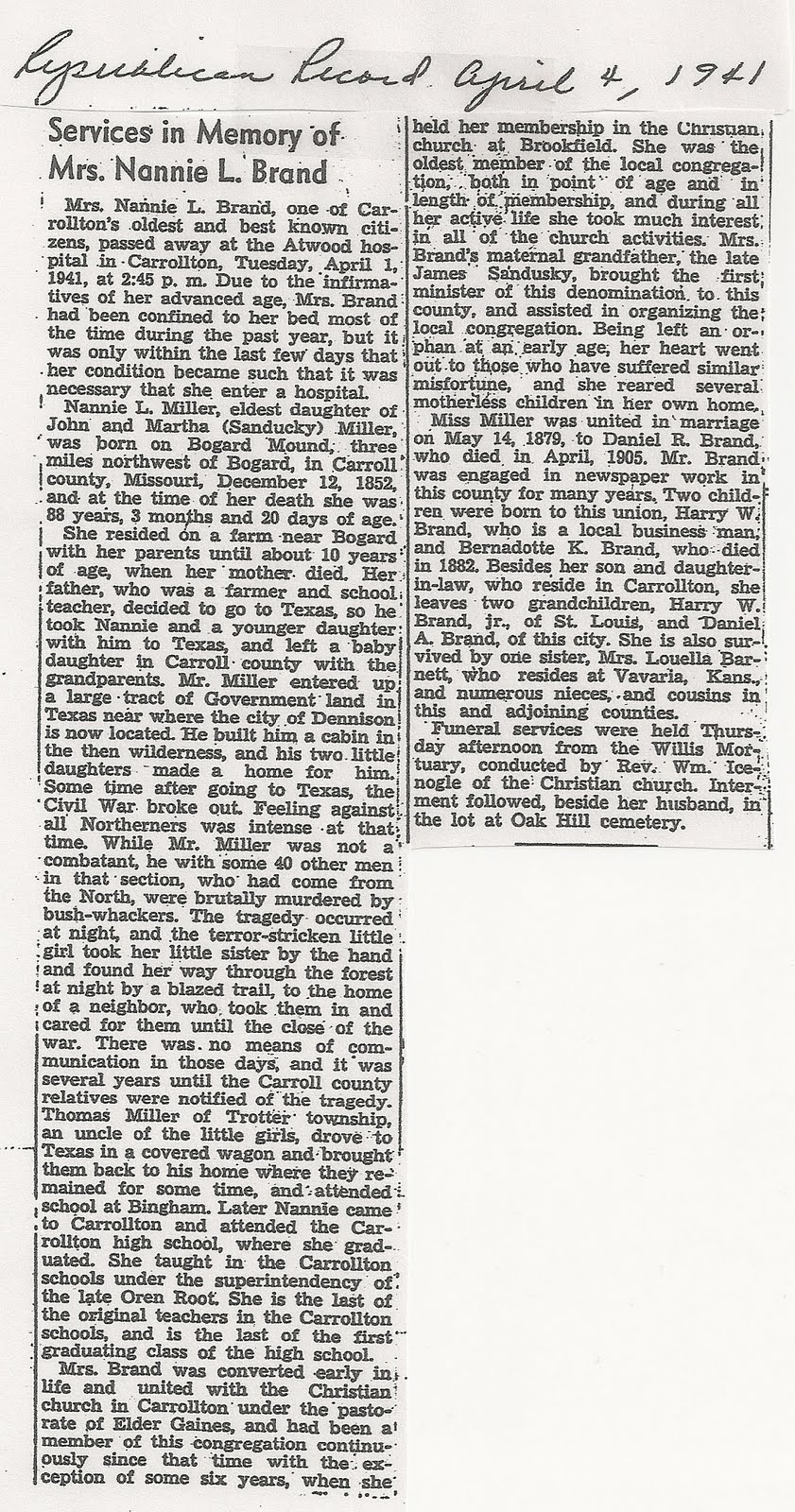
Obituary for Nannie (Nancy) L. Brand, daughter of John M. Miller.  Nannie died at the age of 88 years.  Nannie's obituary recalls the trials and tribulations she suffered during the Gainesville Hanging tragedy almost 80 years before.


The death certificate for Nannie L. Brand, daughter of John M. Miller can be found at http://www.sos.mo.gov/archives/resources/deathcertificates/

John M Miller Posts:

Sunday, November 15, 2009

Rama Dye

This information on Rama Dye has been collected from various databases and web sites.  Not much of it was sourced and not all of it has been verified.

Rama Dye, the son of Fauntleroy and Elizabeth Young Dye, was born about 1821 in Kentucky. He married Sarah Jane Bradley on 16 Jan 1842 in Monroe County, Missouri. Rama moved his family to Texas about 1846 and was issued a land certificate as part of the Peters Colony by 1850 for 640 acres in Cooke County. His brother, Jacob, moved to Texas at the same time as Rama.

Rama Dye and Sarah Jane Bradley had the following family:
1. James Rama Dye was born in Missouri about 1842. James died after 1861.
2. Margaret Elizabeth Dye was born August 18, 1844. Margaret married Nathaniel Bullard. Margaret was a midwife.
3. Leroy Dye was born in Texas 1847. Leroy died February 1850 in Cooke County, TX, at 2 years of age.
4. Rachael Dye was born in Cooke County, TX March 1850. Rachael died after 1920 at 70 years of age. Rachel lived with her sister, Margaret, and brother-in-law, Nathaniel Bullard.
5. Thomas Dye was born in Cooke County, TX about 1855.

1850 Census
Source Citation: 1850 Federal Census; Census Place: Cooke County, Texas; Roll M432_910; Pages: 69-70; Household 23/24
In the 1850 Census, R. (Rama) Dye is on the bottom of  page 69 and his family continues on the top of the next page.


1856 Rama Dye gave land for use as school house to Cooke County on Nov. 7,1856. (Deed Bk 1, pg 593)

Rama's wife, Sarah, died before the 4th of July1860, because she is not listed in the 1860 Census, which was taken on that date.
1860 Census
1860 U.S. Census, Texas, Cooke, Gainesville, page 239

On 27 Jun 1861 in Cooke County, Texas, Rama married Mary Ann Dawson, daughter of Arphax Dawson.  Arphax Dawson was one of the victims of the Great Hanging.  Mary Ann lost both her husband and her father during the 'Great Hanging.'

Rama Dye donated land to the Christian Church in the SE corner of Cooke County.  He was a minister and farmer.

Rama was a second cousin to Martha Ellen YOUNG, mother of the future President of the United States, Harry S. TRUMAN.   Their common ancestor was John Young and wife, Ann.

1862 Cooke County, TX Deed Records: Ramy Dye sold 320 acres to J.B. and R.H. Ruryear July 26, 1862.

Rama Dye meeting for the rescue of M. D. Harper.
Rama Dye was a good friend to M. D. Harper.  Dye was upset when Harper was arrested for being a member of the Peace Party and called a meeting at his home to discuss the rescue of his friend, Harper, and others who were being held as prisoners by the viliante committee.  The following is from Tainted Breeze page 71:  "...nighttime meeting of settlers in the Eastern Cross Timbers who were 'noisy to be led on to the assistance of their friends'. They had convened at the request of Rama Dye, a former Peters Colonist who ironically had spent the day guarding prisoners in Gainesville. Dye was distraught about the arrest of M. D. Harper -- a "resolute and uncompromising" organizer of the Peace party -- and had called the meeting that night to discuss a rescue."
At that first meeting, the group discussed the options of rescue for Harper and the other prisoners, of fleeing, of surrender or a fight or bushwhacking campaign.  Dye was elected as their captain and they planned to meet again the next night to further discuss what to do after they had gathered more information. 
Diamond's Account of the hanging identifies as being present at the first meeting: William B. Anderson, Benjamin C. Barnes, Barnibus Burch, Henry Cockrum, Arphax R.Dawson, Rama Dye, Hudson J. Esman, James T. Foster, Curd Goss, William W. Johnson, David M. Leffel, John M. Miller, John W. Morris, James A. Powers, and Gilbert Smith.  All these men just mentioned who were present at that first meeting were later executed.  Others may have been present, such as Obediah B. Atkinson, William Boyles, Robert Duncan, Harry Gilman, Moses Powers, S. Snodgrass, John Ware, Isham Welch, and John Wiley.

TRIAL OF RAMA DYE
Taken from the Southwestern Historical Quarterly Vol. LXVI, Jan. 1963, No. 3:
The State of Texas vs. Ramey Dye. Charge: Disloyalty or Treason.
Testimony of Arphax Dawson: (Arphax Dawson was born in Ga. in 1805. He was one of the first settlers of Cooke Co. His daughter Mary was married to Ramey Dye).
Witness: RAMEY DYE came to my house and told me that M.D. Harper had been arrested on the charge with being connected with our society and that there would be a meeting held that night (1 Oct. 1862) near Lattimer's and Ritchies steam mill for the purpose of consulting how to rescue Harper. He wished me to attend and bring my gun, which I did. The meeting was attended by RAMEY DYE, JOHN M. WILEY, ISHAM WELCH, WM. BOYLES, JOHN WARE, H. GILMAN, ROBT. DUNCAN, and others.He talked about the recue Harper. We came to the conclusion that the force at Gainesville was too strong for us to accomplish our purpose.
Testimony of Ben F. Barnes:
Witness: There was a meeting at the steam mill last Wednesday night. Some members observed we had better go to the Northern army where we could fare better. They were to hold a meeting the next night, somewhere. RAMEY DYE was appointed Captain.
Testimony of I.W. MORRIS:
Witness: I was at the meeting at Ritchie's Mill. Dr. Foster said the purpose of the meeting was to rescue Harper; and he wanted us to take our guns and go - myself and Ramey Dye. The reason we did not go to rescue Harper was a messenger, ESSMAN, told us that there were a great many soldiers in Gainesville and we were then afraid.
Testimony of GILBERT SMITH:
Witness: I was at the meeting on Wednesday night. Present: RAMEY DYE, JAMES POWERS, MOSES POWERS, JOHN WARE, JOHN W. MORRIS, Dr. FOSTER, H.J. ESSMAN, HARRY GILMAN, ARPHAX DAWSON, O.B. ATKINSON, and WM. BOYLES. We were all ordered to bring our guns. I loaded mine after I got there. I suppose there were 28 men in all.Our object was to come here (Gainesville) and rescue the prisoners. RAMEY DYE was chosen Captain. We concluded to get away when ESSMAN came and reported the number of men in town. We adjourned to meet again the next night and consult what to do. I understood we had spies out. Mr. Welch started up here to see how many men were in town. He was sent by the company. Some men were sent out two or three times to spy out and see if anybody approached. Old man COCHRAN went over to Red River to see how many members of the Order there, were over there in that section. SNODGRASS was there when I arrived. I understood that the signs would protect us when the Northern army came.
Dye was found guilty and hung.

Rama Dye Will
After Rama was found guilty by the citizens court and sentenced to be hanged, he wrote a will which can be found in the Cooke County court probate records. 

Cooke County Probate Records, Vol. 1, pages 327, 329, 330, 338 & 343.
Will Dated Oct. 13, 1862
The State of Texas. In the name of God, Amen, County of Cooke. I Rama Dye of the County of Cooke State aforesaid being of sound mind and memory and considering the uncertainty of this frail and transitory life, do therefore make, ordain, publish, and declare this to be my last will and testament, that is to say, first after all my lawful debts are paid, and discharged, the residue of my estate real and personal, I give, bequeath, and dispose of as follows, to wit. To my beloved wife, Mary Ann Dye, My Daughter, Margaret E. and Rachael Dye, and my son (s?) Rama J. Dye all my property, to be divided equally among my heirs above named.Likewise, I make, constitute, and appoint my Brother Jacob Dye to be executor of this my last will and testament, hereby revoking all former wills by me made.I further wish that my Estate may not be probated, but that an Inventory of all my property may be recorded in the Probate Court.In witness whereof I hereunto subscribe my name, and affixed my seal, using scroll?

this thirteenth day of October AD 1862
/s Rama Dye/seal/

BURIAL:
Excerpt from "Ben Dye and County Line Community" article:
"Rama Dye was summoned to Gainesville, October 1862, charged with being a member of "the Clan", and was hanged for his political views. Ben R. Dye, oldest son of Jacob Dye, heard what had happened, so he hitched a yoke of oxen to the wagon and went to Gainesville, drove the wagon under the body of his uncle, cut the rope and the body fell into the wagon. Burial of Rama Dye was made on his farm. No men could be found to assist with the digging the grave, so some women brought a blanket and helped Ben bury his uncle. All of the men had "hid out" for fear of the infuriated hanging mob. No mention has been made that any sort of a coffin was made, only a blanket for a shroud. Rama Dye was County Treasurer of Cooke county at this time."

QUESTIONS concerning Rama Dye:
Did he have children with his second wife, Mary Ann Dawson??

Family members attend dedication ceremony

This newspaper article is from the GAINESVILLE DAILY REGISTER, Cooke County's only daily newspaper, Gainesville Texas. October 26, 2009 03:26 pm

Great Hanging victim's family members attend dedication ceremony
NATALIA JONES Register Staff Writer

— A special dedication ceremony was held Saturday, Oct. 24 to honor the Clark Cemetery where Nathaniel Miles Clark, a Great Hanging victim, and his family are buried.

An official Texas Historical Marker was unveiled during the ceremony. The marker tells a brief summary of the historic cemetery which was established by the Hatcher family and others sometime in the 1850s.

During the Civil War, the cemetery became known as the Clark Cemetery named for a pioneering Cooke County family.

Great-grandson of Nathaniel Clark, author L.D. Clark was present to retell his family’s past.

“This cemetery has been hallowed ground to the Clark family for 147 years,” he said. “I’ve been around for 87 of those years, so I have had an opportunity to learn a great deal about the history of this place...There’s a great deal of sorrow in it and there’s a great deal of tragedy in it, but there’s also a great deal of thanksgiving just for having this place to share with the family.”

Nathaniel Clark was among the unionists who were lynched in the Great Hanging in Gainesville, in 1862. He was buried in the Clark Cemetery by his widow, Mahuldah Clark, and their 17-year-old daughter and 15-year-old son.

Great-great granddaughter of Nathaniel and Mahuldah Clark, Colleen Clark Cari was also present to extend a warm welcome and introduction to guests.

Prior to the event, she said, over 125 members of the Clark family met at the Lone Oak Ranch and Retreat in Gainesville for a family reunion.

Special guests present for the dedication included Ron Melugin, chair of the Cooke County Historical Commission, Cooke County Judge John Roane and Commissioner Steve Key.

Boy Scouts Troop No. 668 of the First Baptist Church gave the presentation of colors, while Miles Nathaniel Shaffer, great-great-great-grandson of Nathaniel and Mahuldah Clark, led the Pledge of Allegiance.

Music during the ceremony was provided by Dana Freeman, fourth great-granddaughter of Nathaniel and Mahuldah Clark; Larry Clark, great-great-grandson of Nathaniel and Mahuldah Clark; Pam Clark Boaz, third great-granddaughter of Nathaniel and Mahuldah Clark; and Mary Faye Jackson.

Nancy Blackwell, great-great-granddaughter of Nathaniel and Mahduldah Clark, also read a poem entitled “Dear Ancestor.”

Clark Cemetery is located at the intersection of Clark Road and County Road 220.

L.D. Clark also served as the guest speaker for the third annual Commemoration of the Great Hanging which took place Sunday, Oct. 25 at 2 p.m. in Georgia Bass Park.

Thursday, September 17, 2009

Lydia Field McCool -- Her Story Continues

Lydia Field McCool suffered great heartache and much loss during the Gainesville Hangings. Both, her husband and father were killed in the fall of 1862. Henry Field, Lydia’s father, was the third man tried by the so-called "Citizen’s Court" in Gaineville and was executed by hanging on October 4th.  Lydia’s husband, William A. McCool, was captured by James D. Young , convicted by a court martial and hanged at Young’s Red River plantation in the later part of 1862, sometime after the Hangings in Gainesville.

Adding to the heartache and stress, Lydia was expecting a child when her father and her husband were hanged in the fall of 1862.  When her new baby boy was born, Lydia named him William after her deceased husband. Little William was born in 1863 in Texas.  It is hard to even imagine the grief, sorrow and fear, Lydia must have felt during this time.  The two men who were her protectors had just been killed by a ruthless mob and Lydia was left pregnant and alone on the Texas frontier.

Sometime after the death of her husband and prior to 1867, Lydia married a man by the last name of Tullis. Lydia had one daughter by this husband and named her Marietta. Marietta was born about 1867 in Texas. What happened to this second husband is unknown, but by 1870 he is no longer in the picture.

Prior to June 1870, Lydia left Texas and moved back to Iowa with her two young children. It would be interesting to know how she traveled from Texas to Iowa with her two young children.  In the 1870 census, Lydia had can be found living in Bellevue, Iowa, with her maternal grandparents, Daniel and Jersusha Potter, and her older sister, Laura Field. Her two children, William McCool and Marietta Tullis, are with her.

About 1876, Lydia married a third time to Robert Coulehan. They had two children, Agnes born 1876 and Lulu born 1884.

The Robert and Lydia Coulehan family can be found living in Bellevue, Iowa in 1880. Lydia’s children from three marriages are living in the household: Agnes Coulehan - age 2, Ettie Tullis age - 13 and William McCool – age 17.

The Coulehan family moved to Boulder, Colorado by 1900. Lydia's daughter, LuLu, is the only child still living in the home. Lydia states that she gave birth to six children and only 4 were still living in 1900.  Lydia and her husband Robert have a boarding house and four male lodgers are living in the home. Lydia’s daughter, Agnes, is living in Denver and working as a stenographer. The 1900 whereabouts of Lydia’s two older children, William McCool and Marietta Tullis is not known at this time and will take further research.

By the time Lydia is sixty-four years old, she is widowed again. She is found living in Long Beach, California with her daughter and son-in-law, Agnes and Claude Blakemore. One of Agnes Blakemore’s sons became well-known in the southern California banking world.

Thanks to a comment left, the burial place for Lydia has been found.  Lydia was buried in the Angelus Rosedale Cemetery in Los Angeles,  CA.  A picture of the headstone can be found on FindaGrave.com.  The inscription on the bottom of the headstone reads:
"TO KNOW HER WAS TO LOVE HER"

Any additional information on Lydia and her son, William McCool, would be appreciated. Thanks

Monday, August 24, 2009

Photo of Eli Sigler Thomas & wife, Susan Mary Hedenberg Thomas


This is a photo of Doctor Eli Sigler Thomas and his wife, Susan Mary Hendenburg Thomas.
Doctor Eli Sigler Thomas was one of the men killed in the Gainesville Hanging. He was hanged on 19 Oct 1862, along with nineteen other men. He left behind a wife and two children.
Information on Eli Sigler Thomas can be found in several earlier posts:
http://gainesvilletx1862.blogspot.com/2008/11/doctor-eli-sigler-thomas.html
http://gainesvilletx1862.blogspot.com/2008/11/more-on-eli-s-thomas-family.html

Many thanks to the Dr. Eli Sigler Thomas descendant who sent this photo to the blog.  This is one of two known photos of a victim of the Great Hanging.

Thursday, August 20, 2009

Henry Field

Henry S. Field, the son of Henry and Lucinda Frisbee Field, was born 12 Feb 1810 in Elbridge, New York. He settled in Bellevue, Jackson, Iowa in 1838. In 1842, Henry married Jane Augustine Potter. They had four daughters and one son: Laura, Julia, Lydia, Marcus, Jane. Henry's wife, Jane, died in 1848. Henry then married Mary Ann Bail on the 4th of July 1850 in Iowa. They can be found in the 1850 Census (Jackson County, Iowa) that was taken in September of that year.

Henry and Mary had five children, two sons and three daughters: Marcus, Gratia, Martyna, Willliam and Sarah. Sometime around 1857, Henry and Mary moved their family from Iowa to Texas. The youngest two children were born in Texas. They can be found in Cooke County, Texas in the 1860 Census. Henry listed his occupation as a shoemaker. He had $800 in personal estate and no real estate.


The following is from McCaslin's book:
"The Citizen's Court tried Henry S. Field, a shoemaker, after they condemned the Chiles brothers. Henry Chiles had admitted that he initiated Field, and a neighbor recalled a conversation in which Field unwisely asserted that if conscription were expanded to include men his age, he would rather hang than serve in the army. Field had also intemperately applauded General Benjamin F. Butler's infamous proclamation, made during his occupation of New Orleans, that any female who showed contempt for a soldier of the United States Army would be treated 'as a woman of the town plying her occupation,' and carried with him a newspaper containing the edict. Field denied being a member of the Peace party but, after being returned before the jury, admitted that he had taken the first degree from Chiles and 'afterwards did go through' a full initiation. He insisted he would have confessed earlier, before the arrests, but was afraid."

After being sentenced to hang by the Citizen's court, Henry wrote a will on 3 October 1862. Below is a copy of the will (transcript follows):


Cooke County Probate Minutes, vol. 1, 1857-1863; FHL US/CAN Film 1290682
Abstract
3 Oct 1862
"I Henry Field of Texas in the county of Cooke..I desire to be decently and privately buried in the yard near my residence with as little expense as may be, also I give and bequeath my daughter Lydia C. McKool three cows and calves also one colt known as the Roan Filley for her own use and benefit, Also I give and bequeath my wife Mary Ann Field for her and my infant childrens benefit and maintanence consisting in the public land improvement where she resides, also two large mares and one filley, one yearling colt and one colt, also two wagons, also all the remainder of cattle and all movable effects, after paying all my debts. I do hereby appoint and constitute my said wife M.F. sole executrix of this my last will and testament...
the third day of Oct 1862
Henry Field (seal)"

Diamond's account of the trials states, "Fields was called by his neighbors a clever man, and a useful citizen. His implication in this secret and wicked plot astonished the people, more perhaps, than any others."
Henry Field was hanged on October 4th. He made a speech just prior to being hanged and confessed that he was a member of the Peace Party. He also pleaded for charity toward his memory and toward "those who bear my name and are attached to me by kindred ties."

A Field family descendant posted the following on Ancestry.com's World tree (accessed 28 Oct 2007) contact unknown:
"Henry Field, Jr., son of Henry and Lucinda, settled in Bellevue, Iowa, in 1838. In 1854 they moved to Bolivar, Texas, where he resided at the breaking out of the rebellion of the slave-holding states with other northern families. He with eighteen of his neighbors were arrested for refusing to take up arms in the Confederate service, and being refused the privilege of returning north, were hung December, 1862. He wrote a farewell letter to his family of which his family ( Dorothy Dorchester Melville, his great, great niece) has a copy. He had five children by his first wife, Jane, and five children by his second wife, Mary Bail."
There are a few mistakes in the above family account, but it interesting to note the mention of a farewell written to his family.

Notes on the second wife of Henry Field, Mary Ann Bail Field. There is a marriage record for marriage record for Mary Ann Fields to Jefferson Anderson in Cooke County, Texas on 10 Dec 1863. But if this was the widow of Henry Field, then she changed her name from Anderson back to Field by 1900. Mary Field or Mary Anderson cannot be found in the census records for 1870 or 1880. But, Mary Field is found living with her daughter, Martyna, & son-in-law, James Jennings, in the Census records of 1900, 1910 & 1920. She gives her name as Mary Field in all three census records. Mary stated in the 1900 census that she gave birth to 6 children and only one (1) was still living in 1900 -- that would be her daughter, Martyna Field Jennings. Mary Ann Bail Field lived to be almost 92 years old. Her life was touched with hardship and sorrow -- she lost her husband in the Great Hanging of 1862 and five of her six children by 1900. But hopefully, she also experienced peace and joy during her life. Mary died 1 Oct 1921 in Lamar, Colorado, while living with her daughter, Martyna.
Question: Where was Mary living during the 1870 & 1880 census?

For a post about Henry's daughter, Lydia Field, click here.

Thursday, December 4, 2008

Lydia Field McCool "Much esteemed for her modesty, beauty and virtuous refinement"

Lydia Field was the daughter of  Henry Field and Jane Augustine Potter. Lydia was born 12 Dec 1845 in Iowa. She moved with her father and step-mother, Mary Ann Bail, to Texas in about 1856. The family is found living in Cooke County, Texas in 1860. Lydia's father, Henry Field, is listed as a 45 year old shoemaker with no real estate and $800 personal estate value.

When Lydia is 15 years old, she married William McCool (17 Feb 1861 Cooke County, Texas).
According to McCaslin, Lydia allegedly eloped with William McCool and then they settled nearby. McCool "joined William C. Twitty's company during May, 1861, in Gainesville, but never reported for mustering. He paid taxes in 1862 in Cooke County on two cattle, and that summer joined Randolph's Partisan Battalion."

William McCool, along with two others from Randolph's command, A. N. Johnson and John M. Cottrell, were captured by James D. Young. After a confederate court martial presided over by Randolph, all three men were found guilty of treason against the Confederacy and hanged at the Young's Red River home.

Lydia Field McCool lost both her husband and father as a result of Confederate control in Cooke County during the Great Hanging in Gainesville. Lydia's father, Henry, wrote a will the day before he was hanged. Henry Field left to his daughter, Lydia, the following: "three cows and calves also one colt known as the Roan Filley for her own use and benefit."

Diamond's Account of the Great Hanging states this about the McCools:
"William McCool, who was hung with Johnson and Cottrell, was the son-in-law of Henry Fields, who was hung early after the organization of the Court.
Mrs. McCool, the daughter of Fields, is a lady much esteemed for her modesty, beauty and virtuous refinement. She was attached to her husband by the strongest ties of affection. But a short time previous she had secretly abandoned her father's roof, to join her destiny to her bold and determined lover. How sad and melancholly the reflection that she who loved so well could not have loved more wisely. Or why could he not, 'Taste the honey, and not wound the flower.'"
George Washington Diamond's Account of the Great Hanging at Gainesville, 1862, Manuscript Edited by Sam Acheson and Julie, The Southwestern Historical Quarterly, Vol. LXVI, January, 1963, No. 3, pages 404.

Go to an update on Lydia Field McCool.


Lynching or Hanging

Was the "Great Hanging at Gainesville" a Hanging or Lynching??

LYNCHING
A lynching is when a few people (often a vigilance committee) decide the punishment for another person or persons. It is an execution (usually by hanging) without the due process of law, often under the pretext of service to justice, race or tradition.
The victim of the lynching may or may not have committed a crime. The ringleaders or social elite would rile up a crowd or vigilance committee, who would then feel justified because of the assumed guilt of the victim. The leaders and members of the vigilante committee would often serve as prosecutor, judge, jury and executioner. The issue of the victim's guilt was secondary to the passions and objectives of the accusers. Measures taken by vigilance committees often resorted to hasty injustice and were at best extralegal . In early Texas, it was often considered a form "frontier justice" and was more common in areas where there was not an established legal system.

HANGING
A hanging follows due process under the Rule of Law. It involves a trial in a legal court of law with a judge and jury. It has many rules of evidence. The defense gets to face the accusers. The accused is assumed innocent until proven guilty in a legal court of law.

The Handbook of Texas Online states this:
"The stresses of the Civil War, such as racism, regional loyalties, political factionalism, economic tension, and the growth of the abolition movement, inured people to violence in a way that seemed to make lynching increasingly easy to contemplate. War-generated tensions produced the greatest mass lynching in the history of the state, the Great Hanging at Gainesville, when vigilantes hanged forty-one suspected Unionists during a thirteen-day period in October 1862. "

Friday, November 28, 2008

Henry Cockrum Family Update

Below is the information gathered so far on the Henry Cockrum family. Any additional information, corrections or comments would be appreciated.

Henry Cockrum 1,2,3,4,5,6,7,8 was born about 1831 in Missouri. Henry lived in Fannin County, Texas in 1850. He purchased land in Cooke County in 1858. By 1860, Henry had moved his family to the Choctaw Nation (Indian Lands). He was back in Cooke County by 1862. He died on 13 Oct 1862 in Gainesville, Cooke, Texas as a victim of "The Great Hanging at Gainesville, Texas 1862".

Question?? The 1860 Census has children in the household that don't seem to fit into the family. Were these extra children in the household, nieces & nephews, grandchildren, foster kids, or did they belong to Henry & Elizabeth? In the 1900 Census, Elizabeth states she gave birth to 6 children and 4 where still living. We need help figuring out all the children!!

Henry married13 Elizabeth Lackey Petell Jones 9,10,11,12, called "Lizzy,"on 19 May 1849 in Fannin County, Texas. Henry was her third husband. Elizabeth was born on 6 Mar 1820 in Kentucky.
Elizabeth was first married to John Petell. After he died, she married a second time to (unknown given-name) Jones. On her marriage record to Henry Cockrum, she is listed as Elizabeth Jones.
By 1870, Elizabeth had moved her family to Lawrence County, Missouri. In 1900, she is living with a grand-daughter in Indian Territory. She died on 10 Apr 1906 in Oil Center, Pontotoc, Oklahoma. She was buried in Box X Cemetery, Pontotoc, Oklahoma.

Henry and Elizabeth had the following children:
i. Amanda Cockrum was born on 2 Apr 1850 in Texas. She died14 on 8 Feb 1921 in El Reno, Canadian, Oklahoma.
Amanda married (1) William Martin Elliott 15,16 on 20 May 1866 in , Cooke, Texas. William was born about 1838. He died on 14 May 1875 in , Cooke, Texas. Mande and William lived near the Red River where William ran a ferry boat at Horse Shoe Bend (now in Lake Texoma). William was murdered 14 May 1875 while trying to collect a debt.
Amanda married (2) James Franklin Meler on 7 Jun 1877 in Cooke Co., Texas. James was born in Dec 1856 in Alabama. He died17 on 3 Oct 1923 in El Reno, Canadian Co., Oklahoma.
ii. Lucinda Cockrum was born on 17 Oct 1854 in Texas. She died on 25 Jun 1921 in Oklahoma. She was buried in Rosedale Cemetery, Ada, Pontotoc, Oklahoma.
Lucinda married Franklin Travis Jones about 1878 in Texas. Franklin was born on 13 Apr 1853 in Grayson, Texas.
iii. William Henry Cockrum was born about 1856 in Texas. He died in May 1889 in Dexter, Cooke, Texas.
William married Alveria Harriet Ford on 22 Jul 1875 in Cooke, Texas. Alveria was born in Apr 1859.
iv. Edward Cockrum was born on 17 Dec 1860 in Cooke, Texas. He died18 on 23 Apr 1924 in Joplin, Jasper, Missouri.
Edward married (1) Joycie F. Morton . Joycie was born on 18 Aug 1855 in Granby, Newton, Missouri. She died on 2 Dec 1913 in Joplin, Jasper, Missouri.
Edward married (2) Mary Smith .

Elizabeth was first married to John Petell on 8 Feb 1838 in , Pike, Illinois.
Elizabeth and John had the following known children:
v. John W. Petell was born about 1843 in Illinois.
vi. M. Petell, a female, was born about 1839 in Illinois.
Could this be the 22 year old Malvina in the 1860 census???

Elizabeth then married second husband, (unknown given-name) Jones about 1846.
They had one known child – a daughter born about 1848. She was listed as “A. Jones” in the 1850 census.
vii. A. Jones , a female, was born about 1848 in Texas.

Sources
1. Gainesville Great Hanging Sources."One of forty Union sympathizing citizens of North Texas who were charged with treason against the Confederacy by a Citizens Court in Gainesville, Cooke County in October 1862 and then executed in the Great Hanging at Gainesville.References:1. Richard B. McCaslin, "Tainted Breeze, The Great Hanging at Gainesville, Texas, 1862" (Baton Rouge, Louisiana: Louisiana State University Press, 1994).2. George W. Diamond, "Account of the Great Hanging at Gainesville, 1862" SOUTHWESTERN HISTORICAL QUARTERLY, Vol. 66, no. 3, January, 1963, p. 331-414, edited by Sam Acheson and Julie Ann Hudson
O'Connell.3. James L. Clark, "Civil War Recollections of James Lemuel Clark, Including Previously Unpublished Material On The Great Hanging at Gainesville, Texas In October, 1862" (College Station, Texas: Texas A&M University Press, 1984).".
2. George Washington Diamond's Account of the Great Hanging at Gainesville, 1862, ManuscripteEdited by Sam Acheson and Julie, The Southwestern Historical Quarterly, Vol. LXVI, January, 1963, No. 3, pages 331-414, pg .397.George W. Diamond was a brother of secessionists, John R. Diamond and James J. Diamond, who was a principal in the Great Hanging. After the hangings and the adjournment of the court, Diamond was given the records for the purpose of "preserving them and so disposing of them that the history of its (Citizen's Court) transactions might be perpetuated and justice done to those who participated in its deliberations. Diamond's compilation of "memoranda" was to be offered to the public as a just vindicaton of the conduct of those whose judgements were under national criticism. The members of the court examined Diamond's account and gave their unanimous and unqualified approval."pg 397The State vs. C. A. Jones("HumpBack"), James Powers ("Carpenter"), Eli M. Scott, Thomas Baker ("Old Man"), Geo W Anderson, Abraham McNeese, Henry Cochran ("30"), C.F. Anderson, Wm Wernell, B.F. Barnes ("35 or 40"), Wm Rodes, and N. M. Clark ("25").Disloyalty & Treason.The testimony against the above mentioned conspirators corresponds with the testimony herein before produced on the trial of Childs, Fields, Harper, Lock, and others. They all acknowledged their connection with the organization, and made full confession of their guilt at the gallows.===pg 398 Witness in trial against Ramey DayBen F. Barnes sworn.(Witness)I was at the meeting at Richie's Mill. Dr. Foster said the object of the meeting was to resue Harper; and he wanted us to take our guns and go -- myself and Ramey Dye. The reason we did not go to rescue Harper was because a messenger (Essman) told us that there were a great many soldiers in Gainesville and we were then afraid."
3. Connor, Seymour V. , Peters Colony of Texas, A History and Biographical Sketches of the Early Settlers, Texas State Historical Association; Austin; 1959."page 222 "Henry Cockrum was issued a certificate by the county court of Cooke County for 640 acres. Since his claim was later disallowed, it is doubtful that he was a bona fide colonist."(**note: There is also a Edward Cockrum listed as receiving a certificate for 320 acres in Cooke County and in 1857 having his claim also disallowed.)."
4. Probate Record, Cooke County Probate Book 1, page 380-381, Sep 1863."Cooke County Probate Book 1, page 380-381, 5 September 1863(bottom of page 380 and continuing on top of page 381)Appraisement Bill of the Community property of Henry Cockrum, Decd70 head of sheep @ $4 280.0035 head of stock cattle @$9 315.001 Yoke of Oxen $100 & 19 head of horses @ $80 1620.001span mules $400 & 1 bay horse $200 600.002 head of hogs @ $10 160 acres of land @$2 340.00160 acres of land & improvements 250.002 setts of harnes & one wagon 175.00Farming tools $25 2 log chains $14 39.001 corss but saw $10 1 box of tools $15 35.001 note $80 Debt on Doct Martin $350 430.00
1 block $25 Household furniture $150 175.002 steers @ $40 80.00 Total $4,329.00Page 381The State of TexasCounty of CookeThis is to certify that I have made a true and correct exhibit of all the property belonging to the estate of Henry Cockrum Decd, that has come to my knowledge.Elizabeth CockrumSworn to subscribed before me this 28th day of September AD 1863Saml Gooding, Clerk."
5. 1850 U.S. Census, Texas, Fannin County, Household #1, pg 142."In the 1850 Fannin County, Texas census, household #1Henry (Harry) Cockran, age 19, farmer, born MissouriElizabeth Cockran, age 26, born KentuckyA. Cockran, age 2/12 months, female, born TexasJno. W. Petell, age 6, born IllinoisM. Petell age 10, female, born IllinoisA. Jones, age 2, female, born Texas."
6. Land/Deed Records."Cooke County Deed Records3 July 1858Purchased 160 acres8 July 1858Purchased 100 acres."
7.
1860 U.S. Census, Choctaw Nation, Indian Lands, Arkansas.
"Name: Henry Cockram Age in 1860: 28 Birth Year: abt 1832 Birthplace: Missouri Home in 1860: Choctaw Nation, Indian Lands, Arkansas Gender: Male Value of real estate: Household Members: Name Age
Henry Cockram, 28 Elizabeth Cockram, 36 Malvina Cockram, 22 Isafena Cockram, 13 Susana Cockram, 9 Luanda Cockram, 8 Wm Henry Cockram, 5 Edward Cockram, 3 Catharine Cockram. 6 Malinda Cockram, 5 Manuel Cockram, 4 John Hoosier, 8.12 Source Citation: Year: 1860; Census Place: Choctaw Nation, Indian Lands, Arkansas; Roll: M653_52; Page: 1211; Image: 740.Source Information: Ancestry.com. 1860 United States Federal Census [database on-line]. Provo, UT, USA: The Generations Network, Inc., 2004. Original data: United States of America, Bureau of the Census. Eighth Census of the United States, 1860. Washington, D.C.: National Archives and Records Administration, 1860. M653,."
8. Family Information."I am sorry it has taken me so long to get this out to you. I have had a very_busy couple of weeks._I am attaching six family group sheets for William Henry Cockrum, his_children and grandchildren._My husband's family descends through Amanda Cockrum Meler's daughter Alice._Alice was quite a person in her younger years. As a result Amanda raised_Novva Cockran (one of Alice's marriages was to William Cockran-no relation)._This is my husband's grandmother. She lived to be 100 years old. Amanda had told her that she watched her father hang and Novva passed this story down to the family. I have corresponded with a few Meler relatives and a few_Elliot relatives so I know there are many descendants out there._The information on Preston, Isom and some on William Henry comes from "A_History of the Cockrum Family in America" by Emmett Cockrum. There is a_family that is posted on Ancestry that has a different ancestry for William_Henry. I have not done enough research on this family to know which I think_is correct._I have a copy of the marriage cert for William and Elizabeth Jones. Given_that there were children in the census named Peters and Jones, it is_possible that Elizabeth was married before. The cert does not identify her_as Mrs. Jones. They could have been taking care of others children also._Elizabeth is buried in Box X Cemetery, Pontotoc County, OK. Amanda and Frank_Meler are buried in El Reno, OK. I have copies of the records from the Cooke_County Courthouse regarding the property left by William Henry. William_Henry filed for land in Fannin County. William Henry, Elizabeth and family_are in the Fannin County census in 1850 and Jacks Fork, Indian Territory_census in 1860. _If I come across anything else I will let you know. It has been several_years since I have worked on this family line. Please let me know if these_come through alright and if there is anything else I can do._R. Sheppard."
9. 1850 U.S. Census, Texas, Fannin County, Household #1, pg 142."In the 1850 Fannin County, Texas census, household #1Henry (Harry) Cockran, age 19, farmer, born MissouriElizabeth Cockran, age 26, born KentuckyA. Cockran, age 2/12 months, female, born TexasJno. W. Petell, age 6, born IllinoisM. Petell age 10, female, born IllinoisA. Jones, age 2, female, born Texas."
10. 1860 U.S. Census, Choctaw Nation, Indian Lands, Arkansas. "Name: Henry Cockram Age in 1860: 28 Birth Year: abt 1832 Birthplace: Missouri Home in 1860: Choctaw Nation, Indian Lands, Arkansas Gender: Male; Value of real estate: Household Members: Name Age Henry Cockram, 28 Elizabeth Cockram, 36 Malvina Cockram, 22 Isafena Cockram, 13 Susana Cockram, 9 Luanda Cockram, 8 Wm Henry Cockram, 5 Edward Cockram, 3 Catharine Cockram. 6 Malinda Cockram, 5 Manuel Cockram, 4 John Hoosier, 8.12 Source Citation: Year: 1860; Census Place: Choctaw Nation, Indian Lands, Arkansas; Roll: M653_52; Page: 1211; Image: 740.Source Information: Ancestry.com. 1860 United States Federal Census [database on-line]. Provo, UT, USA: The Generations Network, Inc., 2004. Original data: United States of America, Bureau of the Census. Eighth Census of the
United States, 1860. Washington, D.C.: National Archives and Records Administration, 1860. M653,."
11.
1870 U.S. Census, Mount Pleasant, Lawrence, Missouri.
"Name: Elizabeth Cochrum Estimated Birth Year: abt 1821 Age in 1870: 49 Birthplace: Kentucky Home in 1870: Mount Pleasant, Lawrence, Missouri Post Office: Mount Vernon Race: White Gender: Female Value of real estate: No Real Estate
Household Members: Name Age Elizabeth Cochrum, 49 Susan Cochrum, 17 Lucinda Cochrum, 16 William H Cochrum, 13 Edward Cochrum, 11 Malinda Petell, 14 John Petell, 10 (Note: Who are the Petell children? Elizabeth’s children by John Petell are listed in the 1850 census for the Cockrum family. Could these Petell children be Elizabeth's grandchildren from the 10 year old female in the 1850 census??) Source Citation: Year: 1870; Census Place: Mount Pleasant, Lawrence, Missouri; Roll: M593_787; Page: 458; Image: 86.Source Information: Ancestry.com. 1870 United States Federal Census [database on-line]. Provo, UT, USA: The Generations Network, Inc., 2003. Original data: 1870."
12. 1900 U.S. Census, Township 4, Chickasaw Nation, Indian Territory; page 41, ED 120, 7 Jul 1900. "Note: Living with granddaughter's family, Annie McCurry, daugther of Lucinda Jones.Name: Lizzy Cochran Home in 1900: Township 4, Chickasaw Nation, Indian Territory Age: 81 Born: Mar 1819; Birthplace: Kentucky Race: White; Relationship to head-of-house: Mother-in-law (should read grandmother-in-law)Household Members: Name Age Daniel McCurry, 29 Annie McCurry, 19 Arthur McCurry, 4 Myrtle McCurry, 1 Lizzy Cochran, 81, Mar 1819, widowed, 6 births 4 living, Kentucky, Kentucky, Kentucky Source Citation: Year: 1900; Census Place: Township 4, Chickasaw Nation, Indian Territory; Roll: T623 1846; .Source Information: Ancestry.com. 1900 United States Federal Census [database on-line]. Provo, UT, USA: The Generations Network, Inc., 2004. Original data: United States of America, Bureau of the Census. Twelfth Census of the United States, 1900. Washington, D.C.: National Archives and Records Administration, 1900. T623."
13. Marriage Record, Texas Marriage Collection, 1814-1909; Ancestry.com. "Name: Henry Cochrum Marriage Date: 19 May 1849 Spouse: Elizabeth Jones Marriage County: Fannin Marriage State: Texas Source: Texas Marriages, 1814-1909 Source Information: Ancestry.com. Texas Marriage Collection, 1814-1909 and 1966-2002 [database on-line]. Provo, UT, USA: The Generations Network, Inc., 2005."
14. Cemetery Records."Amanda is buried in El Reno, OK's only cemetery next to her husband. They are buried in the old section,
Block 39, Lot 4, Grave C."
15. Family Tradition & Stories. "It was at Dexter,Tx that William ran the Ferryboat. Martin Elliott Jr is my GG Grandfather and I have the data to show my Great X (10) Grandparents. Rabourn Elliott was also a brother to William Elliott and he was my Great grand father and he married Elvoria (Elvira) Brown (Elliott) he too ran the Ferryboat and died in 1875 Cooke Co Tx. Willim Elliott had been killed by horse thiefs and ones that owed him a debt. We have proof of this and it is on his Grave marker at Burneyville,Ok. When Rabour died, that left my Grandfather to run the Dexter Ferryboat along with my Grandmother Annie Jane Hilton (Elliott) His name, Doc McHenry Elliott and like to be called Big Doc Elliott. He was thirteen years old when he began to run the Ferryboat. I have articles on Him and my grandmother. They called him "The Riverboat Man" and Her "The Boat Woman" She loved the River and didnt want to leave and go back to Love Co Marietta, Oklahoma where they both lived and died. Most of the Elliotts are in that part of the country today. My Grandpa Doc was forced to take Bonnie and Clyde Parker (outlaws) over into Texas by means of the Red River. He use to lay around on the porch and tell me the stories.From Cockrum Genforum."
16. Family Tradition & Stories. "Mande and William lived near the Red River where William ran a ferry boat at Horse Shoe Bend (now in Lake Texoma). William was murdered 14 May 1875 while trying to collect a debt."
17. Cemetery Records ."Amanda is buried in El Reno, OK's only cemetery next to her husband. They are buried in the old section, Block 39, Lot 4, Grave C."
18. Death Certificate, http://www.sos.mo.gov/archives/resources/deathcertificates/."Missouri Death Certificate Edward Cockrum Death: April 23, 1924, Jasper Joplin 11619 Birth: December 17, 1860, Cooke County, Texas Father: Wm Cockrum Mother: unknown Informant: Mary Cockrum (2nd wife to Edward)."