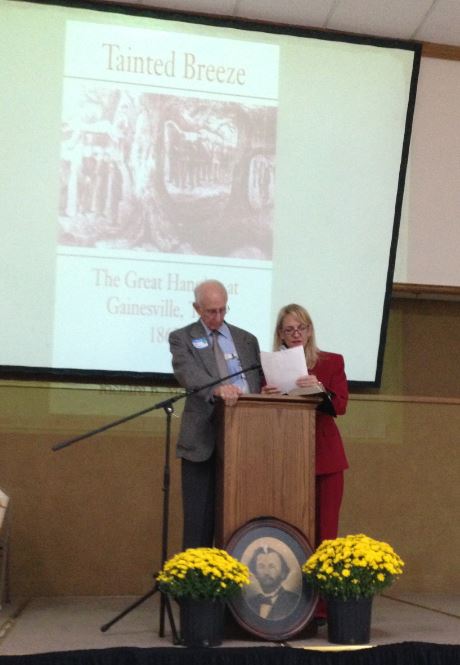
Sunday, February 12, 2012

Preacher...Not the kind that preached for the Money

HIRAM KILBORN
"A Baptist Preacher, and not the kind that preached for the money in it."

Hiram was rounded up with all the rest of the men in the pre-dawn hours of October 1.  He was trying to get away when he was shot by one of the militia sent to arrest all of the men.  Wonder if they shot him in the back?

Hiram Kilborn seems like he was a good man.  Here is what is known of his story: 

Hiram was a native of Canada.  Not certain when he immigrated to the United States.  He was in Peoria, Illinois in 1841, when he married twenty-one year old, Adelia (known as Delia) Ann Knowles a native of Vermont, on 12 Dec 1841.  The couple was still in Peoria in 1850.  Hiram reported his occupation as a carpenter for the 1850 census.  Hiram and Delia have two sons, George, age 6, and John, age 3.

1850 US Federal Census, Peoria, Illinois, page 240A

Hiram moved his family to Texas sometime between 1852 and 1856.  In 1860, Hiram and his family can be found living in Cooke County, Texas.  Kilborn is living next to Eli Scott, one of the men who would latter be hanged in the Gainesville Hanging.  Clark, also, refers to Hiram Kilborn as being a 'near neighbor.'  Kilborn reported his occupation as a farmer in 1860.  Hiram and Delia have two more children by 1860; a daughter, Frances, and a son, Wilson.

1860 US Federal Census, Cooke, Texas, pag 227

Hiram seems to have been very involved in the community.  McCaslin refers to Kilborn as a Baptist lay minister and states in the footnote on page 67 of his book, Tainted Breeze: "Kilborn became a school trustee and a road overseer for Cooke County in September, 1858, a supervisor for the polling station at Henry Cockrum's mill in the fall of 1860, and again for the polling station at John Ware's house in the fall of 1860 and in August, 1862."

James Lemuel Clark, in his Recollections, writes the following about Kilborn:
"The next neighbor I will name was Hiram kilborn.  He had a homestead of 320 acres of land patened to him by the state.  Tho tha did not hang him.  He was shot an killed by some of the Bourland men in trying to git a way.  His foalks never got his body and did not no what tha dun with it.  He Kilborn was a Babtist preacher, and not one of the kind that preached for the money that was in it.  He was the oanly Babtist preacher in this country when we came here.  I am informed by Frank Foremen that [he] helped to bury Kilborn."

Hiram's son, George, was away fighting for the Confederate Army, when Hiram was shot and killed by the Confederate group in Cooke County,   James L. Clark was serving in the same Confederate unit.  In one of Clark's letters home to his family, dated 20 Mar 1863, he writes: "Mother tell George Kilborns folks that he is still with us but it not verry well.  He has a verry bad cough and it is thought by some that he has Consumption.  But he is able to go about.  He has not been able to do any duty since he left home but has been able to stay with us."  George A. Kilborn appened the following note to James Lemuel Clark's letter: "Be sure and tell my Father and Mother to write to me as soon as you get this letter and tell them where I am.  I send my best respects to you and your family.  Geo. A. Kilborn."

It appears that while George Kilborn was away fighting for the Confederate Army, he did not know that his father had been killed by the Cooke County confederates.  No records for George have been found after this time, so he most likely while serving in the Confederate Army.  That would mean that his mother lost both her husband and son during the Civil War.

After Hiram's death at the hands of the Confederate militia, his widow and family moved to Bourban County, Kansas.  Delia and her three younger children can be found in the 1870 census for Bourbon County.

1870 US Federal Census, Fort Scott, Bourbon County, Kansas, page 491B

Delia died in 1879 and was buried in the Mount Orum Cemetery, Bourbon County, Kansas. Son, John, married and had a family and continued to live in Bourbon County. Son, Wilson, moved around a bit, ending up in Colorado.

Friday, February 10, 2012

WHY THIS BLOG?

Often the question is asked, “Why do a Blog about a Civil War Hanging?”
Additional comments include: "Who cares about that?, How depressing!, You are not like one of those guys who dress up like Civil War Soldiers, are you?, What does that have to do with anything today?, Why waste your time?"

The Blog Welcome, on the right side of the blog, explains the goal or mission statement of the blog:
     Our goal is to remember all the men who died in the 'Great Hanging'
     and find their families – spouse, children, parents, siblings.

But, the real question that should be asked, is not “Why the blog?” but, “What prompted you to start the blog in the first place?”

That's easy.  While reading the book by Thomas Barrett, “The Great Hanging,” the following passage on page eighteen seemed to jump out of the book demanding attention and action.

“There was an order passed that women should not be permitted to be present at the hanging. The women were not noisy, but the signs of deep despair was manifested by the heaving breast, the falling tears, the heavy groans as though the heart was breaking, and all the vitals of life were giving way. I believe all these men were heads of families. The sun set that night on fourteen widowed families, and thirteen families of orphans, for if I recollect right, all these men had children but one.
Language is totally incompetent to express the deep sorrow of that night. Wailing, moaning, weeping and lamentation existed in these families on that dark and fatal night. Tears fell like the rain drop, as tears fall from my eyes at even this distant day, while penning these lines. When the little ones who were just beginning to talk, would say: Ma where is pa? Pa come home, O, ma, go after him. How these words went like a dagger to the heart of that disconsolate wife. He was her husband, she loved him! Let the world say what they may.”

Who were these women?? -- these widows, mothers, and daughters of the Gainesville Hanging victims?

One thing was certain, these women needed their story told. They needed a voice! They needed to be found!  In many cases, who these women were, was not known to present day researchers. Many women are still not known, but many have been “found” since this blog was started and their sad but courageous story is finally being told.

For a list of known spouses of the men hanged at Gainesville, go the the "Weeping Wives" post.  It is updated as new information is found.

If you have information on any of the families of the Hanging victims, please share. There are many ways to share: write a book, start your own blog, post your family information on Ancestry.com, leave a message on genealogy message boards, donate your stories to a historical society/library in Gainesville, post the information on this blog, and/or all of the above.


Thomas Barrett, "The Great Hanging at Gainesville, Cooke County, Texas, October, A.D. 1862," Gainesville, Texas: January, 1885; Old West Magazine, pages 49-66, Summer 1981, Note: Original pamphlet was written in 1885. Its author, Thomas Barrett, was on the Cooke County jury that found 42 men guilty of conspiracy against the Confederacy in the Fall of 1862. According to the Handbook on Texas, Barrent "deprecated the role of emotion in the jury's decisions and argued that his being on the jury had saved large numbers of lives." Note: Barrett did NOT mention names of the victims.

Tuesday, February 7, 2012

The John Wiley Question?

Was John Wiley Hanged in the Gainesville Hangings?

The following information was sent by a John Wiley descendant.  Some in the Wiley family feel that their ancestor, John Wiley, was one of the men hanged during the Gainesville Hangings in 1862.  Wiley is included in James L. Clark's list of men who were hanged.  In addition, Wiley is mention in the 1880 Galveston news article about the hanging.  But, he is NOT reported in Diamond's Account as having a trial, nor is he included in McCaslin's list, "Forty-Two Executed by the Citizens Court at Gainesville."

"I have been seeking more information relating to John M Wiley [1812-1862]. I found one unverified source that indicated that his middle name was Malcolm. He was married to Elizabeth "Eliza" "Lizzie" Ann McCulloch [1820-1877] and there were six known children, five girls and one boy. Avaline [B1837], Mary Jane [B1840], Eliza [B1841], Isaac [B1843], Sarah Ann [B1845] and Maria Louisa [B1849] All the children were born in Missouri. The family was living in Jefferson County, Missouri in the 1850 census. They moved to Grayson County in 1854 and were in the Grayson County census in 1860.

Wiley is not on Diamond or McCaslin's hanged lists, but is mentioned by Clark and in the article by the Galveston News Weekly in 1880 as being hanged.

The widow, Eliza was living in the 1870 Grayson County census with her son Isaac and a 8 years old child named James M Wiley who may be the child of Isaac and the grandchild of Eliza. None of the girls are in the home. It appears that the family did not flee the area after the hanging but stayed in Grayson County. Isaac was born 1843 and died in 1924. He was married to Margaret Ellen Hutton and they had several children. They apparently lived near Collinsville in Grayson County and are both buried in the Collinsville Cemetery.

Eliza Wiley died in 1877 and was buried in Wiley Cemetery near Collinsville near her husband, J M Wiley. This cemetery is small with maybe 5 or 6 graves and located about 2 miles SE of Collinsville. None of the graves there appear to be on Find-A-Grave website. Not sure if they are marked or not. Clark calls him "old man Wiley-landowner" in his account.

The only reference I can find about John M Wiley in Diamond's account is that he was present at the Dye meeting on the night of 1 October 1862. This was mentioned in testimony in one of the first seven trials. There is no evidence that Wiley had a trial, but he was hanged on the 12th, so would likely have been one of the 14 men that was selected from a list by a representative of the citizens mob provided to them by the jury for lynching. It does appear however, that he was picked up by his family or friends and buried in a traditional manner by his family and not in the mass grave on the banks of Pecan Creek."

Diamond's Account - List of Trials

THE FOLLOWING LIST IS FROM DIAMOND’S ACCOUNT OF THOSE TRIED AND EXECUTED DURING THE GREAT HANGING AT GAINESVILLE, TEXAS, OCTOBER 1862.


This list is the order of each man’s trial as presented in Diamond’s Account of the Citizens Court, with the date of hanging listed after each name.  (Most hanging dates came from McCaslin's book, Tainted Breeze.)

Dr. Henry Childs – Oct 2
Ephraim Childs – Oct 2
A.D. Scott - Oct 19
M.D. Harper – Oct 4
Henry Fields – Oct 4
I.W.P. Lock – Oct 7
W.W. Morris – Oct 8
Richard Anderson - Oct 19
Dr. Eli Thomas – Oct 19

TRIED TOGETHER:
Edward Hampton - Oct 10
John A. Morris – Oct 19

John M. Crisp – Oct 19
Samuel Carmichael – Oct 13

TRIED TOGETHER - Oct 13
C.A. Jones, James Powers, Eli M. Scott, Thomas Baker, Geo W. Anderson, Abraham McNeese, Henry Cockrum, C.F. Anderson, Wm Wernell, B.F. Barnes, Wm Rodes, & N.M. Clark

Ramey Dye – Oct 13

D.M. Leffel – Oct 19

TRIED TOGETHER – Oct 19
James A. Ward & W.B. Taylor

H.J. Esman – Oct 19

W.W. Johnson – Oct 19

Richard N. Martin – Oct 19

Barnabas Birch – Oct 19

TRIED TOGETHER – Oct 19
Curd Goss, Wm Anderson, John Miller, Ar (Phax) Dawson, & M.W. Morris
======

SHOT WHILE TRYING TO ESCAPE:
Dr. James Foster – Oct 10

TRIED BY COURT-MARTIAL AND EXECUTED BY MILITARY:
A.N. Johnson & John Cottrell (together, with Wm McCool)

SHOT WHILE TRYING TO ESCAPE:
Mr. Floyd
 
Note:  Three of the men (not sure which ones) with an execution date of Oct 13 were hanged on Oct 12.  Nineteen men were executed on Oct 19, and this list only shows 17 trials for men who supposedly were hanged on the 19th.  McCaslin lists John W. Morris and Gilbert Smith with the men who were hanged on Oct 19, but Diamond does not list a trial for them.  As always, corrections are welcomed.

Saturday, February 4, 2012

Gilbert Smith

Was Gilbert Smith hanged in the Gaineville Hangings? 

Gilbert Smith is listed by McCaslin as one of the "Forty-Two Executed by the Citizens Court at Gainesville."

McCaslin (Tainted Breeze, page 203) suggests that Gilbert Smith, age twenty-three, is listed as being in a militia company from Fannin County mustered on July 7, 1861.  The twenty-three year old Gilbert Smith in Fannin County can be found in the 1860 Fannin County, Texas Census.  He was the son of Robert Smith and he lived in Fannin County until his death in 1915.  So, the Gilbert Smith from Fannin County could not have been hanged in the 1862 Gainesville Hangings.

There is another Gilbert Smith reported in the 1860 census as living in Texas.  He was a 60 year old family man living in Hopkins County.   The Hopkins County Gilbert Smith died in 1868, so he could not have died in the Gainesville Hangings in 1862.

The 1860 census of Texas reports one more Gilbert Smith.  He was a 29 year old native of Georgia living in Rusk County.  His 21 year old wife, Mary, was a native of Texas.  They were parents of an eleven month old son, named Ira.  It is not known what happened to this Rusk County Gilbert Smith, so he may be a possibility.

Known facts about Gilbert Smith:

1. Witness for the trial of Ramey Dye.
Diamond's Account (page 78) gives the following testimony by Gilbert Smith for the trial of Ramey Dye:
"I was at the meeting on Wednesday night.  Present: Ramey Dye, James Powers, Moses Powers, John Ware, John W. Morris, Dr. Foster, H.J. Esman, Harry Gilman, Arphax Dawson, O. B. Atkinson, and Wm boyles.  We were all ordered to bring our guns.  I loaded mine after I got there.  I suppose there were twenty-eight men in all.
Our object was to come here, (Gainesville) and rescue the prisoners.  Ramey Dye was chosen captain.  We concluded to get away when Essman came and reported the number of men in town.  We adjourned to meet again the next night and consult what to do.  I understood we had spies out.  Mr. Welch started up here to see how many men were in town.  He was sent by the company.  Some men were sent out two or three times to spy out and see if any body approached.  Old Man Cochran went over to Red River to see how many members of the order there were over in that section.  Snodgrass was there when I arrived.  I understood that the signs would protect us when the Northern army came."

2. Attended the Rama Dye meeting for the rescue of prisoners.
As stated in his above listed testimony, Gilbert Smith attended the nighttime meeting called by Rama Dye to discuss a rescue of prisoners in Gainesville.

3. Diamond does not list or include Gilbert Smith in any of the trials.  So, did he have a trial and Diamond not list it?  Was he found guilty and hanged?  There is no record of Gilbert Smith ever being tried or hanged.  Was he just a witness? Or, was he a prisoner and then released? 
Gilbert Smith is not on Clark's list of men hanged, nor is he in the 1880 Galveston news article.  But, neither one of these sources contains a complete list of men hanged.  Not even sure if Diamond's account contains a complete list of men hanged.

Thoughts and comments about the Gilbert Smith dilemma would be appreciated.


Note:  McCaslin's book, Tainted Breeze, is the definitive source for information concerning the Great Hanging at Gainesville.  When McCaslin published the book in 1994, there were not online census indices available.  Nor was there as much information available that today can be easily found in online databases or offline repositories about the individual men who died in the Hanging.  Many thanks to McCaslin for his book about the Hanging, and for laying the groundwork for further research by descendants into their ancestor who died in the hangings.

Friday, February 3, 2012

Star-Telegram News Article

The following was posted on the Bud Kennedy Column, Fort Worth Star-Telegram 
Mobs don't lynch people - 'tensions of the times' lynch people


Mobs don't lynch people - 'tensions of the times' lynch people

Posted Thursday, Feb. 02, 2012
By Bud Kennedy
bud@star-telegram.com

It remains the worst mob violence in American history: 14 men lynched, all here in North Texas.
Now, 150 years later, a Rebel-flag-waving movie will tell the mob's "side of the story."
Even by Civil War standards, the Great Hanging is an atrocity.

After a Confederate military tribunal convicted seven men of treason, a vigilante mob set out on the streets of Gainesville and Cooke County, rounding up and hanging 14 more men without regard for trials or the young Confederate nation's constitution.

"The whole town went crazy," said Gary D. Bray, 60, of Forney, a Sons of Confederate Veterans commander lining up extras for the SCV promotional movie Black October.
Bray said the Confederate ancestry group will "tell both sides."
"Everything you read on the Internet says the Confederates were just crazy people lynching folks in a big mob," Bray said.

Well, yes.

But Bray said the movie will blame the lynchings on the "tensions of the time."
By the time the bloodshed ended, 42 men had been lynched, shot or hanged by a tribunal, including five in Wise County and one in Denton.
Bray said the movie's director, David Moore of Parker County-based Southern Legacy Films, has talked with descendants.
"By no means would we want to portray the victims as horrible people," Bray said.

How kind.

The screenplay is based on records compiled by a Confederate soldier who was also an East Texas newspaper editor, Bray said. Scenes have been shot near Tyler, at the Frontier Village park in Denison and at Dexter in Cooke County.
Movie scenes posted online include re-enactments of hangings.
The Sons plan to show the movie in Gainesville to mark the October anniversary, he said.

Some graves there remain unmarked to this day.
One in a Cooke County cemetery is inscribed "Murdered by a Mob."

University of North Texas history professor Richard McCaslin told the story fairly in his 1997 book, Tainted Breeze.
"There's only one book that tries to tell the true story, and I wrote it," McCaslin wrote by e-mail.
"They have made no effort to include me, and the pictures online reflect their lack of knowledge about what really happened."

This movie will be more story than history.


Bud Kennedy's column appears in the Star-Telegram Sundays, Wednesdays and Fridays.

Tuesday, January 31, 2012

Samuel Carmichael

Samuel Carmichael was born in Tennessee in 1821 and settled in Cooke County prior to 1860.

The 1860 Cooke County, Texas Federal Census gives the following information about Carmichael. He was a thirty-nine year old carpenter from Tennessee, living in Gainesville with his wife Anna. Samuel had $1,200 of personal property and $40 of real estate. Anna was thirty-seven years old and a native of Illinois. It appears that they had no living children of their own. Living in their household with them are the following individuals; fifteen year old Isaac Abele from Alabama, ten year old Josephus L. Wilson from Norway, and twenty-one year old William Gaston from Pennsylvania. It is not known if the younger children were foster children or apprentices or what?

1860 Federal Census, Cooke County, Texas, Gainesville Post Office, page 223, Dwelling 33


By 1862, Samuel Carmichael was assessed for 5 lots in Gainesville, 7 horses and 2 cows.

From Diamond’s account of the trials, we learn that Samuel Carmichael was “an outspoken enemy to the South.”

Diamond reports the following about the Trial of Samuel Carmichael:
It is in evidence that Carmichael was well informed as to the objects and purposes of the organization, but the testimony does not develop the fact that he was ever sworn in. When the detail was made to go to Fort Cobb during the Indian excitement in that quarter, Carmichael peremptorily refused to go, say that he would fight to the death at home, first.
He was an outspoken enemy to the South and, in every way, considered a dangerous and bad man in Society. He was found guilty and hung.”
Diamond's Account of the Great Hanging, Page 75.

So, it appears that Samuel Carmichael was not even a member of the peace party. Apparently, the Citizens Court thought he was just too outspoken and needed to be hanged. McCaslin referenced a newspaper article in the St. Louis Republic, stating that Carmichael was a “big, strappin’ fellow, not afraid of the devil, and he cussed ‘em to the last.”

Carmichael wrote a will just before he was hanged. He named his wife, Anna, executor and sole heir. He tried to get in a last jab at the Confederates, by requesting that Hughes, his attorney, was to collect all monies that was due to him from the Confederates.


Cooke County, Texas Will Book, Vol 1, pg 330-331


Transcription of Will:
In the name of God Amen. I, Samuel Carmichael in the County of Cooke and State of Texas, being of sound mind and memory, and considering the uncertainty of this frail life, do therefore make ordain publish and declare, this to be my last will and testament. That is to say first after my lawful debts are paid and discharged, the residue of my estate real and personal, I give bequeath and dispose of as follows to wit, To my beloved wife Anna Carmichael all of the property I am now possessed for her own benefit.
Likewise I make constitute and I appoint J. C. Hughes my lawful attorney to collect all monies that may be due me from the Confederate States of America. And receipt in my name to the proper officers for the same hereby ratifying and confirming all that he may do in the premises. Likewise I make, constitute and appoint my wife to be the executrix of this my last will and testament, hereby revoking all former wills by me made.
I also state that I do not wish my will to go into Probate Court but wish for my wife Ann Carmichael to settle up and close the estate for the best advantage to all concerned, there is some Hay put up by Henry Smith and myself one half of which ______
In witness whereof I have hereunto subscribed my name and my seal using scrawl for seal this 13th day of October AD 1862
Samuel Carmichael

Samuel Carmichel was hanged on October 13, 1862.  No known grave, he was probably buried in the mass burial site along the banks of the Pecan Creek, not far from where he was hanged.

It is not known what happened to his wife, Anna Carmichael, after the Hangings.

Those Andersons

Four men with the Anderson surname were hanged at Gainesville during the Great Gainesville Hanging in October 1862. According to McCaslin their names were; C. F. Anderson, George W. Anderson, Richard Anderson and William B. Anderson.

Researching online sites such as Ancestry.com, Fold3.com, WorldVitalRecords.com, FamilySearch.org, Genealogybank.com and Google searching has not provided much in the way of new information to prove who each of the Anderson men could be. Were they random men who happened to have the same surname or were they connected in some way?

Each Anderson will be reviewed with the information found from McCaslin’s book and Diamond’s account. Any additional information will be added to each man.  The most important "new clue" was found in the 1880 Galveston Weekly News article.

Richard Anderson

McCaslin (Tainted Breeze, pg 195): “Richard J. Anderson is listed in the 1860 Grayson County census (F.N. 1,178) as a twenty-eight-year-old farmer from Missouri with $750 in personal property and no real estate. His wife and their three children, the youngest of whom was six years old, were all born in Missouri.”

The census record below is the one referred to by McCaslin. Is the “R. J. Anderson” listed in Grayson County, the Richard Anderson who was hanged? No records have be found to prove or disprove this theory.

1860 US Federal Census; Grayson County, Texas; Roll: M653_1295; Page: 218; Dwelling/Family #:1152/1178.


Richard Anderson was sworn into the Peace Party by JWP Lock at the same time he swore in P. Q. Russell, William Anderson, George Anderson and John Tourly.

According to Diamond’s account of the Hangings, Richard Anderson had his own individual trial, not a group trial. Diamond shares the following about the Richard Anderson trial: “The evidence against this prisoner being the same in substance as that against Harper & Lock, it is deemed unnecessary to repeat it here. He was found guilty, and after [being] sentenced to be hung, made full confession of his guilt.” Since all we have is Diamond’s opinion of the trial, it will never be known exactly what the transpired during the actual trial for Richard Anderson.

C. F. Anderson > E. F. Anderson > Edward Frost Anderson

Anderson was tried in a group trial along with eleven other men. Diamond’s gives the following description of the trial: “The State vs. C. A. Jones, James Powers, Eli M. Scott, Thomas Baker, Geo W. Anderson, Abraham McNeese, Henry Cockhran, C. F. Anderson, Wm Wernell, B. F. Barnes, Wm Rodes and N. M. Clark.” He further states, “The testimony against the above mentioned conspirators corresponds with the testimony herein before produced on the trial of Childs, Fields, Harper, Lock, and others. They all acknowledged their connection with the organization, and made full confession of their guilt at the gallows.”

According to McCaslin, “C. F. Anderson said Lock swore him in and then told him that the organization was for mutual protection when the Federal army came…Lock took the stand in his own defense, saying that he…had organized the Peace party as a protective society, not to attack their neighbors.” During the trial for JWP Lock, “E. F. Anderson” was a witness.

“C” F Anderson from the group trial, and “E” F Anderson, the witness for Lock, are probably the same person. The “E” to a “C” may have been a transcription error. The Anderson man who was hanged was most likely E. F. Anderson. And, his name is probably Edward Frost Anderson, as explained below.

The 1880 Galveston Newspaper article gave the names of three victims of the Hanging whose names were Anderson; “Frosty, George and William Anderson.”


Research on the name of Frosty Anderson comes up with a “Frost Anderson” who lived in Lamar County, Texas in 1850. What is interesting about this Frost Anderson is that his name was Edward Frost Anderson or E. F. Anderson. The Frost Anderson from Lamar County had two sons who were named William (b. 1832) and George W. (b. 1835). Lock, also hanged at Gainesville, was from Lamar County. Frost Anderson and JWP Lock probably knew each other in Lamar County.

1850 Lamar County, Texas Federal Census, Precinct 4, page 285

Anderson Family in 1850:  Frost Anderson, Age 40, born Tennessee;  Matilda Anderson, age 38, born Tennessee;  William Anderson, age 19, born Tennessee;  George W. Anderson, age 15, born Tennessee;  Jessee Anderson, age 13, born Arkansas;  Susan E. Anderson, age 5, born Texas;  Mary A. Anderson, age 3, born Texas;  Thomas D. Anderson, age 1, born Texas.

Frost Anderson cannot be found in the 1860 census in either Lamar or Cooke Counties.  In addition to the children listed in the 1850 census, some family databases have an additional son, John Anderson, who was born about 1830 in Tennessee.

This evidence seems to show that E. F. Anderson who was hanged was most likely Frost Anderson from Lamar County. Two of his sons, William and George, may have been the William Anderson and George W. Anderson who were also hanged.

William Anderson

McCaslin (Tainted Breeze, page 195): “William B. Anderson is listed in the 1860 Cooke County census (F.N. 451) as a twenty-seven-year-old farmer from Tennessee with $175 in personal property. His wife was from Arkansas, but their son, age eight, was born in Texas. Anderson first appears on the tax roll for Cooke County in 1859; he paid only a poll tax for that and the next few years, but in 1862 he was accessed for 2 horses and 7 cattle. He did serve for a period of time in a military unit, because the 1862 tax rolls for Cooke County found in the archives at UNT declare that his payment would be delayed because he had ‘gone to war.’”
1860 Cooke County, Texas Federal Census, page 249


In the above 1860 census, William Anderson is a 27 year old Tennessee native and his wife, Lucinda, is a 17 years old Arkansas native. There is an 8 year old Francis King living in the household, who does not appear to be the son of William or Lucinda. William Anderson in this 1860 Cooke census would be approximately the right age to be the son of Frost Anderson.

A marriage record in Lamar County can be found for William Anderson who married Lucinda Davis on 3 Nov 1855. Lucinda’s father, Abner Davis, can be found on the 1850 census for Lamar County.  He moved to Cooke County, Texas, where he died on 15 May 1859. Lucinda’s widowed mother, Sarah Davis, and Lucinda's siblings can be found living in Cooke County in the 1860 census. Sarah Davis has a 17 year old Catherine King living in the household. Lucinda and William, also, had someone with the name of King living with them.

The age for Lucinda is bothersome, because she would only be about 13 years old when she married. Marrying at such a young age is not unheard of, but also not all that common. I personally had a great-aunt who married at the age of 13 years old in the 1920’s. So, although uncommon, young marriages could and did happen.

The big question is whether or not William Anderson, with wife, Lucinda, in 1860 Cooke County and hanged in the Great Hangings, is the same William Anderson who married Lucinda Davis in Lamar County. Evidence seems to support the fact that both are the same man. Also, evidence seems to point to the fact that William Anderson is the son of Frost Anderson of Lamar County.

William Anderson was tried and condemned to death by the "Citizens Court" in a group trial, along with Curd Goss, John Miller, Arphax Dawson, and M. W. Morris. Diamond (Diamond's Account, page 85) stated of this group trial, "These prisoners all acknowledged their guilt, giving the signs, grip, and password, and were active members of Capt Ramey Dye's company. All found guilty and hung."
William was hanged on 19 Oct 1862. His body was probably buried at the mass burial grave site.

It is not known what happened to Lucinda after the 1860 census, or if William and Lucinda had any children.


George W. Anderson

McCaslin (Tainted Breeze, page 195): “George W. Anderson first appears in the Cooke County tax roll for 1862, when he paid taxes on $124 in property, including 1 horse and 4 cows.”

According to Jackson Mounts’ testimony in Lock's Trial, he (Mounts) was sworn into the Peace party at the same time as “P Q Russell, Wm Anderson, George Anderson, John Tourly, and Richard Anderson.”

George W. Anderson was tried in the same group trial as C. F. Anderson (who may be Frost Anderson). He was found guilty along with the group and was hanged on October 13, 1862.  He was buried in the mass grave burial site.

The above information is all that is found from Diamond's Account and McCaslin's Book about George W. Anderson.

In the Lamar County 1850 household of Frost Anderson, there was a 15 year old George W. Anderson. It is very likely that he is the same George W. Anderson who was hanged in the Gainesville Hangings.  He could have moved to Cooke County around the same time as his brother, William.  Both men are on the 1862 Cooke County, Texas tax roll.

It is not known if George W. Anderson was married or had any children.


Conclusion:
Evidence seems to point to Edward Frost Anderson, and two of his sons, William and George, being hanged during the Great Hanging at Gainesville in 1862.  One has to wonder how this could happen without some mention being made in a record, newspaper or document.  Three men from the same family should have made some news.

Any help or thoughts on the Andersons would be appreciated. Thanks.

Monday, January 30, 2012

What is Lock's Given Name??

J. W. P. Lock was one of the organizers of the secret society known as the Peace Party. In the account of his trial, Diamond (Diamond, pg 66) refers to Lock as "I. W. P. Lock." But, Anderson, one of the witnesses for Lock's trial, calls him "Wm Lock."  McCaslin (Tainted Breeze, pg. 78, 87, 105, 200) refers to Lock as "Leander W. P. Jacob Lock."  Was his name Leander or Jacob or William or all of the above?  Census records, a marriage record and Diamond's account all list him with only initials -- "J.W.P. Lock"
Note: the “I” in Diamond's account is most likely a “J” that was a transcription error. The first witness in Lock's trial is I. H. Mounts, who is also referred to as Jackson H. Mounts. So, it stands to reason that the “I” in Lock’s name is also a misspelling and should be “J. W. P. Lock”. “J” and “I” are often transcribed wrong by inexperienced transcribers.

It appears that McCaslin combined two people together to come up with the name of "Leander W. P. Jacob Lock."  There is a JWP Lock in the 1850 Lamar County, Texas census. He was a 29 year old native of Tennessee. A family headed by Leander Locke is also found in the 1850 Lamar census. As shown from the census records below, they are definitely two separate individuals. But, they could possibly be related.
The Lock referred to Diamond's account would be the 29 yr old farmer, JWP Lock listed in 1850 Lamar County.  He was living with his wife, Deannah, and two daughters.  The value of his real estate was $1688.

1850 Lamar County Texas Census, Precinct 8, Page 458, Line 29, 458/458

The above Lock is also recorded in the 1850 Agricultrual Schedule for Lamar County, Texas. This time his first given name is recorded: Jacob P. W. Lock. This is the only offical record found so far with his give name of "Jacob" recorded.


 Leander Lock also living in Lamar County in 1850.
1850 Lamar County Texas Census, Precinct 6, Page 293, Line 1, 363/363, Farmer; Leander Lock, White Male, age 39, b. Tennessee, his wife, Sarah, and 5 daughters.  This same Leander Lock can be found in the 1860, 1870 and 1880 census records for Lamar County, Texas. So, he cannot be the Lock who was hanged in Gainesville in 1862.

JWP Lock's wife, Deannah, died sometime between 1850 and 1853, although probably early in 1853.  The 1850 census with wife, Deannah, lists two daughters, Emily (b. 1841) and Ann (b. 1849).   Lock gets married again on 5 June 1853 to Evaline Dale in Lamar County, Texas.  The name on the marriage record is J. W. P. Lock. The 1860 census with wife, Evaline, lists two daughters, Diana (b. 1853) and Arazona (b. 1858).  The older two daughters are not listed and it is not known if they are still living.  Could daughter Diana be a daughter from the first wife, Deannah?  Could she have died giving birth?

In 1860, Lock is living in New Mexico Territory with his family. He may have left Texas after the shooting  (described below).  In the 1860 census, Lock is a 38 year old miner living at the Pino Alto Gold Mines with his wife, Eveline, and two daughters. Four boarders are also living in the household.


1860 Census Pino Alto Gold Mines, Dona Ana, New Mexico Territory

McCaslin (pg 105) states that Throckmorton asserted that Leander W. P. "Jacob" Lock, whom he identified as the leader of the "Association," had been acquitted of murder several years earlier in Lamar County."
Throckmorton may have been referring to the following murder in Grayson County, Texas (Dallas Weekly Herald, 22 June 1859).
Transcription of above
"The Sherman 'Texian' records the killing of Howard W. Hales, in the county of Grayson. He had had some difficulty with his wife, who left him and took refuge with at her father's house, to which she was followed by her husband. On reaching the house, Hales made some hostil demonstrations against the family, he was shot at from an outhouse by two young men named Lock, nephews of Mrs. Hales father, sixty or seventy buckshot taking effect, and killing him instantly."
Note: Name may be Harrell instead of Hales.  See below news article.

Another newspaper article, that refers to the above shooting.  This is probably where the confusion over Lock's give name came from. 


Conclusion:
All records indicate that Jacob W. P. Lock was the man who died in the Gainesville Hangings.
His full name may be Jacob William P. Lock.  Leander Lock is a seperate person and is not the man who was hanged at Gainesville.
The parents for Jacob W. P Lock are not known at this time.  If and how he might be related to Leander Lock of Lamar County, Texas is not known.
Any additional comments or information would be appreciated.  Thanks.

TRIAL OF J. W. P. LOCK

Diamond's Account of the Trial of I. W. P. Lock

The State vs. I. W. P. Lock
Disloyality and Treason

I. H. Mounts sworn.
Witness: I was sworn into this society, by I. W. P. Lock. At the same time, he swore in P. Q. Russell, Wm. Anderson, George Anderson, John Tourly, and Richard Anderson.

E. F. Anderson sworn.
Witness: I know of a secret organization in this country. The prisoner, Wm Lock, told me it was to afford us protection when the Northern Army should come in. Mr. Lock gave me the signs, grip, and password. Lock told me that we were to get powder at Sherman. The design of the organization was the reconstruction of the old Constitution, and Union.

The Prisoner [Lock]: Jackson Mount swore me and I wore him into this organization. I introduced the password “Arizina,” and the signs, and grips of the order. Mount and myself were the first starters of this order. I have heard that there was an organization to break up both armies. I have heard since that it was the same as this; and that the signs and password would protect us when the Northern army come. Mount and myself took two oaths. We were to kill, or assist in killing, every man who should reveal wither the existence of the order or its plans and designs. I advised my men, (Lock had a company,) not to go to the war.

Dr Eli Thomas sworn.
Witness: In a conversation with the prisoner last night (in person) I made a clean breast of the whole matter. Lock said he had scruples about doing so himself, on account of the oaths he had taken in the order.

He was found guilty and hung.

George Washington Diamond's Account of the Great Hanging at Gainesville, 1862, ManuscripteEdited by Sam Acheson and Julie The Southwestern Historical Quarterly, Vol. LXVI, January, 1963, No. 3, pages 331-414.

Note: The “I” in I. W. P Lock is most likely a “J” that was a transcription error. The first witness is I. H. Mounts, who later in the trial is referred to as Jackson H. Mounts. So, it stands to reason that the “I” in Lock’s name is a misspelling also and should be “J. W. P. Lock.”   “J” and “I” are often transcribed wrong by inexperienced transcribers.

Saturday, January 28, 2012

James L. Clark's list of Victims of the Gainesville Hangings

James L. Clark’s list of men “murdered” at Gainesville, 1862

Lemuel D. Clark, ed., The Civil War Recollections of James Lemuel Clark, Including Previously Unpublished Material On The Great Hanging at Gainesville, Texas In October, 1862 (College Station, Texas: Texas A&M University Press, 1984) page 109-112. 

“I will conclude by giving the names of all the men that I pursnoly knew an others that was murdered...In the beginning [I] will give the names of the first settlers that lived in this county when my father came:
One of our near neighbors was William Rhodes. He [came] from North Carolina here, an got 320 acres of land as a homestead from the state. He had a nice famley an his oaldest boy belong to the same company that I belonged to. Now Rhodes sold land to a man by the name of Eli Scott about the time the war started. An Scott moved to the land an was murdered while he lived on the land. He Scott [came] from California here, an had a big famley, an was nice foalks. Him [Scott] an Rhodes were hung the same day. Tha are boath buried on the Rhodes survey, now owned by Sam McClerran.
The next neighbor I will name was Hiram Kilborn. He had a homestead of 320 acres of land patened to him by the state. Tho tha did not hang him. He was shot an killed by some of the Bourland men in trying to git a way. His foalks never got his body an did not no what tha dun with it. He Kilborn was a Babtist preacher, and not one of the kind that preached for the money that was in it. He was the oanly Babtist preacher in this country when we came here. I am informed by Frank Foreman that [he] helped to bury Kilborn.

I will give the names [of others who were hanged] as follows:
Wernell – 160 acres
Richard Martin – landowner
Oald Grandpaw Burch – would talk, say what he thought – landowner
H. J. Esmond – 320 acres
Ward
Evans – Or Quinn
Clem Woods – landholder
Wolsey – landholder
Manon – lived on Preston Road
Oald man Leffel
A. B. McNiece – landholder
Wash Morris – landholder
Wesley Morris – landholder – tha were brothers
Thomas Floyd – shot while under gard – landholder
John Crisp – landholder
James Powers
Rama Dye – oald man – landholder
J. Dawson
Oald Man Wiley – landholder
J. Morris
Barnes
Milburn
W. Anderson
Gross
Ward
Dr. Johnson – nation [probably from the “Indian Nation”]
Childs, Senior
Childs, Junior
Hampton
Locke
Foster
Fields
D. Anderson
D. Taylor
R. Manton
Jones
Carmichael
Henry Cochran
Those names are as tha was give to me by McPherson.
Will McCool and two others were murderd at Bill Young Spring on the river after Welch killed Young in Bourland Hollow."

[Footnote on bottom of page 111]
"JLC often mentions a total of forty-four [hanged].  This list is not complete and many contain some errors in names.  Even the number of men murdered is not known exactly.  The best authorities here seem to be Barrett, Hanging, 21, and Wheeler's diary entry for 19 October 1862.  Both accounts give forty as the number hanged and add that two were shot while trying to escape.  If two were hanged by the military, the numbers then agree.  According to Diamond, three men were hanged by the military.  Diamond, "Account," 402."

BlogNote:  Men mentioned on above list by JL Clark who are NOT on Diamond's list: Evans, Clem Woods, Manon, Wiley, Milburn, Manton.

Saturday, January 21, 2012

WHERE ARE THEY BURIED??? Comment and Follow-up

The following comment was left on on the "WHERE ARE THEY BURIED???" post.  The comment deserves it's own post and thanks the "anonymous" author.

The Burying Place: This location is reported to be near the hanging tree [cut down in 1880 for unknown reason] on the east bank of Pecan Creek about 1/2 mile east of town. It would have been on the far side of a bridge from downtown, although I have not found any reference to a bridge.
In 1867, a Freedmen Bureau agent, Anthony M Bryant, wrote a letter to the Federal authorities requesting that the bodies be exhumed from their mass grave and properly reburied. This request was denied.
I expect that at that time, the location of the burial was common knowledge to many in Cooke County. It would have been hard to conceal in a small town. After, a prisoner was hanged his body was transported back to the old warehouse west of the town square in most cases. Only a few bodies were claimed by relatives because they were afraid to pick them up with the mob in control of the town. Family members were treated as enemies of the state. Remains were left to be buried by the "county". Also it is likely that the bodies started to deteriorate after a few days. This would have been a problem downtown. Some of the bodies were mutilated by hogs because or a hole in the wall of the old warehouse where the bodies were stored. At some point, they had to be buried. Not sure who had this task, but slaves were detailed to make coffins with lumber from an old house that had been torn down for this purpose. There was not enough lumber so some bodies were wrapped in blankets. All were buried in a shallow mass grave on the banks of the creek. Some of the bodies were washed up by heavy rains and the hogs dug some up according to reports. Not exactly a traditional burial.
McCaslin indicates only five traditional burials: Barnibus Burch lies in an unmarked grave on the Marvin Cason farm, James A Powers is buried at John Ware's ranch and has a simple headstone, Nathaniel M Clark is buried in the Clark family cemetery with a large memorial stone, and William W Wernell is buried on the old James L Clark farm, his grave is covered with rocks with a metal marker welded on a post recording his name and his date of death. Also Roma Dye's body was cut down by his nephew, Ben Dye, and taken to his farm in Grayson County and buried in a location now known as the Ben Dye Cemetery. Henry Chiles was picked up by families members and buried in unknown location. An unconfirmed report that Arphax R Dawson was taken back to Grayson County for burial. Also unconfirmed report that John W Wiley was buried in Collinsville by his family. Richard Martin was reportedly picked up by his brother and taken to Hood County in a wagon for burial in unknown location. William Rhodes and Eli Scott were reported by Clark to be buried on the Rhodes survey then owned by Sam McClennen. Possibly a total of eleven bodies that were picked up and buried properly.
This is something that should be addressed. Someday in the future, when evacuating for a new building in Gainesville, they will likely dig up the remains. The mass burial should be located and the remains given a decent burial. I am surprised that the citizens of Gainesville have not done it in the 150 years since it happened. It might be a task for the archaeology department of a major university with expertise. I was at San Jacinto last year, and saw areas of the historic battlefield being evacuated by students from a university. They were marking it off and doing it in the proper way. Hopefully something like this could be done at the hanging site/burial site to locate the mass burial.


Great comment!
Blognote:  It is extremely disturbing that Gainesville City, Cooke County and/or the State of Texas have not tried to lay this issue to rest by locating the mass burial site.  Also, there should be a memorial with all the names of the men who died in the hangings.  There is one more item on the wish list -- Pardons from the State of Texas for all the men who were found guilty in the Gainesville trials and then were hanged or shot.

Wednesday, October 19, 2011

Historians Observe 'Great Hanging'

Last Saturday was the fifth annual Gainesville Hanging Commemoration. The following newspaper article is from the GAINESVILLE DAILY REGISTER, Gainesville Texas. October 18, 2011.

Gainesville Daily Register
October 18, 2011
Historians observe ‘Great Hanging’
By GREG RUSSELL, Register Staff Writer
Gainesville Daily Register

Gainesville — Saturday’s observance of Gainesville’s famed “Great Hanging” of 1862 was intended as more than a memory of troubled times.

Members of the North Central Texas College honors program, Cooke County Historical Commission and Morton Museum Heritage Society hosted a guest lecture on campus by Dr. Richard McCaslin, a historian whose research and renowned publications employ the lesson that “Then is today.”

He said during a phone interview Monday that helping the local public understand factors prompting the Texas Militia to execute more than 40 Civil War-era county residents — innocent of their insurrection charges, by many accounts — can help enhance our modern and more civilized order.

“When troublesome issues arise, it’s really not helpful to look back and say, ‘We’ve always been unified, and have always been together,’” McCaslin said. “We’re as argumentative and indecisive as we’ve always been. Once we understand our pasts better, we understand ourselves now.”

The historian is a faculty member of the University of North Texas history department. His works include The Tainted Breeze: The Great Hanging at Gainesville, Texas, which won prizes from the Texas State Historical Association and the American Association for State and Local History. McCaslin is also a Pulitzer Prize nominee for his book Lee in the Shadow of Washington, and he specializes in examining the warfare of historical Texas, and Southern states.

He proposed Monday that the famed hanging was driven by fear. A group of men were suspected of treason against the South, and civilization had far fewer “stop-gaps” in place to help maintain a nonviolent order.

Among them, he listed policing departments and other law enforcement agencies as we regard them today.

“Homeland Security,” McCaslin cited. “I’m not a big fan of Homeland Security, but it beats the hell outta nothing. Texas Rangers. We have all these structures that we can turn to, to help keep our baser natures in check.”

But, he said, with no such structure to lay a buffer between wartime fear and an unruly public, Cooke County militiamen of 1862 took direct action.

“And I guess the insinuation is, we’d all be capable of doing the same thing at the same time,” McCaslin said. “The flip side is, they didn’t do that in Sherman. They rounded the folks up and tried to send them to Confederate district court, which didn’t work. A lot of them fled. So over in Sherman, they took a different course.”

Annual observance of the Great Hanging became a Cooke County staple in 2006. McCaslin said these observances, plus the historical research that supplies their foundation, can help put old divisions to rest and more clearly inform what actually happened nearly 150 years ago.

“I’m amazed what people come up and tell me they were told happened,” he said Monday. “To bring the event out, and discuss it, and realize what did happen brings a kind of closure. Not for all people. But for most people.”

McCaslin added that in more recent times of war, it can be easy for officials and policymakers to view their actions and motivations as new and original to mankind. They virtually never are; similar decisions occurred in the past and were driven by similar ideas, and horrific consequences often followed.

He also said he’s observed a growing argument among Southern heritage organizations that Southerners, and the Confederacy, owe no apologies as per the Civil War.

“That they did nothing wrong and that everything was perfect,” he said. “That’s not functional, that makes no sense and it creates a kind of dysfunction.”

The Great Hanging remembrance of 2012 will mark the event’s 150th anniversary. McCaslin said he and historian authors L.D. Clark and Thomas Barrett have collaborated on a new book about the hanging while Heritage Society member Steve Gordon organizes activities for a sesquicentennial observance.

Next year’s event may prove more elaborate than the previous have been. But intentions of the organizers remain the same, just as views about the Great Hanging of 1862 continue to vary.

“I think that remembering clearly what happened is the step toward making sure that the same things don’t happen again,” McCaslin said. “This book, and the commemoration, are not meant to chastise anyone.
“But if someone takes a corrective as a chastisement? That can be something that happens. And I’m not sure what you can do about it.”

Thursday, September 29, 2011

Nathaniel Miles Clark

Nathaniel Miles Clark

Probably more is known about Nathaniel Miles Clark (and his family) than any other man who was hanged.  There are several reasons for this; first, Clark’s son, James Lemuel Clark, kept letters, interviewed others and wrote down his memories and recollections of “the greatest tragedy of his lifetime,” and, secondly, the Clark family stayed in Cooke County, Texas keeping the memory of their ancestor alive with frequent reunions over the years.  L. D. Clark, grandson of James Lemuel Clark, took the memoirs and papers of his grandfather, edited them and added an introduction for a book called “Civil War Recollections of James Lemuel Clark and the Great Hanging at Gainesville, Texas in October 1862.”  Anyone serious about learning more about the Great Hanging needs to read Clark's book.

Description from back cover of book:
  "Not all Texas agreed with the decision to secede from the Union in 1860, and while most did abide by the decision, many remained outspoken against the laws of the Confederacy.  Civil War Recollections of James Lemuel Clark is the story of one Texas family who suffered more at the hands of their neighbors than any warring enemy.
The memoirs of James Lemuel Clark describe his involvement in a series of events leading up to the hanging of forty men in Gainesville, Texas.  Eighteen at the outbreak of the Civil War, Clark was the son of one of the men hanged for their Union sympathies in October 1862.  Clark's memoirs also tell of his experiences with the Texas militia in Indian campaigns and with the Condederate Army.  Civil War Recollections gives an overview of the events that shaped the lives of war survivors and influenced the reconstruction of Texas."


Nathaniel Miles Clark was born 26 Jun 1818 in Christian, Kentucky, the son of Lemuel Marion Clark and Anna Henderson.  He married Mahuldah Lutisha Hicklin 7 Jul 1841 in Missouri. In 1850, Nathanial and his family are found living in Cedar County, Missouri.  By that time, the couple had four young children: James, Cordelia, Martha, and William. Just after 1850, the Clark family moved from Missouri to Cooke County, Texas. They are found in the 1860 Census for Cooke County.  Four more children had been added to their  family by 1860: John Boone, Mary, Joseph, and N. M. Douglas. 
Many of Clark’s neighbors in 1860, also lost their lives during the time of the Great Hanging: Thomas Floyd, Wesley Morris, Washington Morris, Eli Scott, Hiram Kilborn.
1860 Census Cooke County, Texas


Nathaniel lost his life along with so many others in the Great Hanging at Gainesville in October, 1862.  His family buried him in the Clark Family Cemetery outside of Gainesville, Cooke County, Texas.  His headstone inscription reads: "Nathaniel Miles Clark June 26, 1816 (should be 1818) Murdered by a Mob October 13, 1862 His last words to his companion Prepare yourself to live and die. I hope to meet in a better world God bless you all"

After Texas seceded from the Union in 1862, Nathaniel's oldest child and son, James Lemuel, was drafted into the Confederate Army.  Ironically, James Lemuel was serving in the Confederate Army at the time his father was lynched. After hearing of the death of his father, James deserted the Confederate Army and returned to Texas for several months to take care of his widowed mother and younger siblings. Upon getting them settled somewhat, he later ventured north to Missouri to join the Union Army, therefore serving on both sides during the Civil War. 

Wednesday, September 28, 2011

2011 Commemoration of Great Hanging

The following info about a commemoration for 2011 was posted on The Great Hanging Group facebook page:

Saturday, October 15, 2011 - Georgia Bass Park, Gainesville, TX  ....think the time will be 5pm.

****UPDATE****UPDATE

NCTC to commenorate Great Hanging
By GREG RUSSELL, Register Staff Writer
Gainesville Daily Register

Gainesville — Gainesville’s infamous “Great Hanging” of 1862 has long been a subject of commemoration.

And Cooke County organizations have collaborated yet again to spotlight this dark chapter in local history with a ceremony and historical lecture.

A press release said the fifth annual “Bell Ringing in Remembrance of the Great Hanging” is set for 5 p.m. Oct. 15, near the main flagpoles of Gainesville’s North Central Texas College campus. Representatives of the college honors program, plus the Heritage Society of the Morton Museum and the Cooke County Historical Commission, have organized the ceremony.

Scheduled guest speaker is historian Dr. Richard McCaslin, chair of the University of North Texas History Department. He’ll offer a lecture about the hanging at 5:30 p.m. in the Little Theater of NCTC’s 100 Building.

All events are free and open to the public.

The release said McCaslin is a speaker and historian who specializes in the histories of Texas, the Civil War and the Wild West. Among other books and articles, he authored The Tainted Breeze: The Great Hanging at Gainesville, Texas, which won prizes from the Texas State Historical Association and the American Association for State and Local History.

More notably, the historian is a Pulitzer Prize nominee for his book Lee in the Shadow of Washington, which won the Laney Prize and the Statten Award. He has been listed in Who’s Who in America, Who’s Who in the South and Southwest, Contemporary Authors, and was elected a fellow of the Texas State Historical Association.

The release quoted NCTC history professor Pat Ledbetter, who said the “Great Hanging” began on Oct. 1, 1862, after the Texas Militia arrested more than 200 suspected Unionists. Vigilantes in Gainesville executed 42 of these men, following convictions on charges of conspiracy to commit treason and fomenting an insurrection.

Gainesville historian Leon Russell had originally spearheaded events to commemorate the hanging. In a Register story about the 2010 ceremony, he discussed the case with visitors.

“Who are these people?” he said about the hanged. “Well, for the most part, they were non-slave owners, with one or two exceptions, and for the most part they were out in the eastern part of the county — and, for the most part, they were grubbing their living out of a little garden spot.

“Most of them would have been subject to the draft, the Confederate draft, and they really didn’t want to go fight the rich man’s war, the planter’s war,” he added. “They left 42 widows and about 170 children.”

Ledbetter said few of the hanged men had actually plotted to insurrect against the Confederacy; many of them were apparently innocent of the charges. But this mattered little to their captors, whose allies also conducted lynchings in nearby counties.

Among this turmoil, Gainesville’s “Great Hanging” reportedly claimed the most lives. Ledbetter added that the hanging shows how the course of the Civil War took shape based on the concerns of 19th Century Southerners.

During the 2010 ceremony, Russell insisted that in life, the “scale of justice” demands balance, even if that balance doesn’t occur until many years later, and in the form of public regret.

“When I first learned of this I thought it was just such a horrible injustice,” Russell said. “And this is a country that’s supposed to have been formed on the basis of justice. What happened to the idea that every man is considered innocent until proven guilty by a competent court by a jury of his peers?

“The people that did it trashed that, and I’m here to speak out against them.”

The Texas State Historical Commission is scheduled to republish a pair of eyewitness accounts of the hanging. Ledbetter said this is because the upcoming commemoration will occur on the eve of its sesquicentennial, which is in 2012.

“Public and academic interest should be strong,” the release quoted her.

150th Commemoration of The Great Hanging - 2012

Mark your calendars for next year's big event!!
The following was posted on The Great Hanging Group facebook page:

The Morton Museum and Cooke County Heritage Society, in conjunction with several local organizations, will sponsor the 150th Commemoration of The Great Hanging - October 12-13, 2012 in Gainesville, Texas.
Over the course of two days, educational events and a roster of historians will address both the Northern and Southern perspective as it pertained to North Texas during the Civil War. A memorial service will be held on October 13th.
More details to follow soon.


Facebook has a Group for the Great Hanging at Gainesville, Texas. If you are a 'Great Hanging of Gainesville' descendant or have an interest in Texas History, you might want to join this group on facebook. Joining this group should keep you updated on all the news concerning the Great Hanging.

The name of the group is: Gainesville Texas - The Great Hanging - October 1862 Civil War
The category of the group is: Common Interest - History
The group description is:
Certainly one of the worst atrocities of the Civil War occurred in Gainesville, Texas in Oct. 1862, when 40 men, suspected of Union sympathies, were hanged.
Searching for descendants of the 42 victims who were hanged in Gainesville, Texas in 1862. An anniversary celebration in October 2012 will mark 150 years since this tragedy - the most mass hangings in the United States.
Photo of Nathaniel Miles Clark, lynched in the Great Hanging in Gainesville, TX on October 13, 1862.

Wednesday, April 20, 2011

"Left me in a sad and mornful condition"

Susan Leffel, widow of David Miller Leffel 

In this post, we will revisit and ponder the letter written by Susan Leffel on 11 Jun 1869 to Governor Edmund J. Davis.   Susan was the widow of  David Miller Leffel, who was killed in the Great Hanging.  In this letter, Susan asked the Governor of Texas for help against the continued harassment to her family and friends, who's loved ones were the victims of the Great Hanging at Gainesville in 1862.  See previous post about the letter. 

To our knowledge, Susan’s letter is the only surviving document written by a widow of a Hanging victim describing her feelings about the hanging and her experiences afterwards.  Susan's experiences and feelings are probably very similar to those of the other widows and family members of men who were killed in the Hangings at Gainesville.

Background info on Susan Leffel: David and Susan Leffel left Ohio where his family lived to move to the Texas frontier where most of her family lived. Susan Emeline West, daughter of Michael West and Susannah McKee, was born 3 Jun 1817 in Kentucky.  Susan married David Miller Leffel on 3 May 1837 in Springfield, Clark, Ohio.  After Susan's mother died in Ohio, her father, Michael West, and several of her brothers moved to Texas before 1848. Michael West and his son, Michael, had obtained land grants as colonists in the Peters Colony in Grayson County.  An older brother, John West, was living in Red River County, Texas.  Father, Michael West, died in 1858 and left his land in Grayson County, Texas to his heirs, which included Susan Leffel.  Sometime right after the death of her father in 1858, Susan and David packed up their young family and moved from Ohio to Grayson County, Texas to claim Susan's inheritance of land left to her by her father.  After moving to Texas in 1858, Susan sells the land she inherited to her brother and then she buys another parcel of land in Grayson County that she later sells to N. H. Holt. Most married women at that time did not buy and sell land on their own.  Also, married women usually did not hold title to land if they had a husband living. Why isn't David's name also on the land that is purchased and then later sold? This suggests that Susan may have been independent, with a mind of her own.  The decision to move from the Northern State of Ohio to a slaveholding state would set in motion events that would eventually lead to David's violent death.

Susan's 1869 letter to Governor Edmund J. Davis of Texas, can be found in the Texas State Archives.  Our impression is that a shy, timid woman did not write that letter.  Susan seems to have been a very strong, outspoken and determined woman.  At the time Susan wrote the letter in 1869, she had been on her own as a widow for almost 7 years.  And, this was during the Civil War and the following reconstruction period.  All the while, Susan was being continually harassed by some of the same group that killed her husband.

Susan starts her letter by recalling the arrest and hanging of her husband, David Miller Leffel. She refers to the citizens court as a vigilante committee and states that many of the husbands were “taken off by those nocturnal visitors and destroyed by the hanging.” McCaslin states that the men were rounded up at daybreak on 1 October 1862, but Susan used the word "nocturnal" which indicates that it was still dark when at least some of the men were arrested.


In the letter, Susan describes her husband, David, as follows:  "kind as he was" and "great source of my comfort and living".  She was not only left in a “sad and mornful condition” after her husband was hanged, but since the end of the war Susan and others who had lost relatives in the hanging had been harassed and plagued by attacks. Members of their families had been arrested “without a sine of a rit or any showing of legal authority whatever.”
 And, when Susan was robbed of “my many jewelry” and household items, no one was arrested.  One has to wonder, just how a pioneer wife and mother came into possession of "many jewelry."  Was the jewelry a handed down keepsake from her mother?  Or, was the jewelry a gift(s) from her dear husband?  Where was the law?  Why did they not help a poor widow?

Just two weeks prior to writing the letter in Jun 1869, a dozen men came to Susan’s home to arrest her son on a charge of horse stealing "without a sine of a rit or any showing of legal authority whatever.” The rebel group fired a shower of 40 or 50 bullets as her son fled, but he was soon apprehended. One of the tormentors, Susan mentioned by name: James Anderson of Sherman. Then, the rebels came into her house and one of the party dragged Susan onto the floor from her sickbed and pistol-whipped her younger son. She sadly concluded, “I with maney others have lost hopes of protection from that party’s abuse by the beloved country and government that we loved so dearely. . . what to do, or where to go to hide from them I can not tell.”

Susan’s final plea for help can’t help but tug at the heartstrings:
“It is indeed hart rendring that my husband, as kind as he was, and great sorce of my comfort & living should be hanged and his helpless family, (with many others) are as barbrsly treated as tho we were even aliving with the Indians; simply for them to take vengance uppon us because we were and are in favor of our Fathers Country and Government.”

In June 1869, Susan was living in Pilot Point when she wrote the letter to the Governor of Texas telling of the continued harassment by southern rebels. She cannot be found in records after June 1869.  And, Susan's whereabouts are not known after that time.

Did Susan die shortly after writing the letter to the Governor?  She mentioned she was "lying sick in bed" when James Anderson jerked her out on the floor.  Did she die from the rough treatment of the men who harassed her?  Did her tormentors come back after she wrote the letter and kill her for speaking out against them?  Susan's death or burial place is not known.

One has to wonder why Susan stayed in Texas instead of returning to the North where her oldest son and several of her brothers lived?  Was she determined to "stick it out" in Texas"?  It appears that she had hoped for peace and protection during reconstruction.  In the last paragraph of the letter, Susan admits to finally losing "hope of protection from that partys abuse by the beloved Country and Government."

Susan was definitely patriotic and loved her country -- the United States of America!  She mentioned being a loyal (lawiel) citizen and being loyal during the war.  She called the United State of America, her "beloved Country and Government" that she "loved so dearly."

Susan's letter to Governor Edmund Davis
Transcription can be found here.


Tuesday, April 19, 2011

Trial for Foster's Murder

E. Junius Foster, Esq. was founder and owner of the Sherman Patriot newspaper until his death in 1863.   Foster condemned the Hangings in Gainesville.  He died at the hands of James D Young and two others, in revenge for a statement Foster published applauding the death of Young's father, Col. Young.
In 1865, an indictment was found against James Young, Charles Cox and Newton Chance for the murder of E. Junius Foster. In 1872, Young was indicted and went through the form of a trial and was acquitted. In 1873, Cox was tried, and on the evidence of Young was also acquitted. Chance had taken off to Indian Territory and could not be found until he came back to the area in 1885. He was arrested and placed on trial twenty-three years after the murder of Foster.

The following newspaper articles tell the story of the trial of Newton Chance for the murder of E. Junius Foster.
Date of publication: September 24, 1885, Location of newspaper: District of Columbia, Paper: Critic-Record

Newspaper article in the Dallas Morning News about the twenty-three year old trial for the murder of E. Junius Foster. 
Publication Date: December 02, 1885, Paper: Dallas Morning News, Dallas, Texas

James Young voluntarily testified that he alone did the shooting, and thus exonerated the defendant, Newton Chance.  Years earlier in the Cox trial, Young testified that he and Cox were sitting upon their horses in the road a hundred yards from where the shooting took place and heard the shooting that killed Foster, but did not know who did the shooting. (Kansas City Star, 4 Dec 1885)

Publication Date: December 10, 1885, Newspaper: New York Times

Newton Chance Aquitted
 
Publication Date: December 04, 1885, Paper: Dallas Morning News, Dallas, Texas